
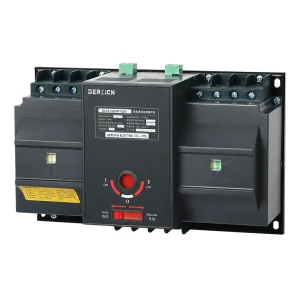
An Automatic Transfer Switch (ATS) is the bridge between a facility’s primary utility source and its emergency backup generator. While most standard applications utilize a 3-pole ATS—switching only the three-phase conductors—critical infrastructure projects increasingly mandate the use of a 4-pole ATS.
The primary difference lies in the treatment of the neutral conductor. In a 4-pole ATS, the neutral is treated as a switched pole, just like the phases. While this adds complexity and cost, it is often a technical requirement to ensure the integrity of the grounding system and the safety of personnel.
The Core Difference: 3-Pole vs. 4-Pole Construction
To understand the necessity of the 4-pole variant, we must first define the physical and electrical distinction:
3-Pole ATS: Only the three phase conductors (L1, L2, L3) are switched. The neutral conductor is “solid,” meaning the neutral from the utility and the neutral from the generator are permanently bonded together at a common neutral bus within the ATS or the distribution board.
4-Pole ATS: All three phases and the neutral conductor are switched. When the ATS transitions from the utility to the generator, it physically disconnects the utility neutral before connecting the generator neutral (or uses an overlapping “make-before-break” contact).
The "Separately Derived System" Requirement
The most common reason for specifying a 4-pole ATS is when the backup power source is classified as a Separately Derived System (SDS).
In electrical engineering, an SDS is a system where the power is derived from a source other than the service utility, and there is no direct electrical connection between the circuit conductors of the two systems, including the neutral.
Grounding at the Generator
If a standby generator is grounded at its own location (the neutral-to-ground bond is made at the generator), it becomes a separately derived system. If you use a 3-pole ATS in this scenario, you create a permanent connection between the utility neutral-ground bond and the generator neutral-ground bond. This results in multiple grounding points for the same neutral, which violates many international electrical codes (such as those based on IEC 60364) and creates significant safety risks.
Preventing Circulating Neutral Currents
When a system has multiple neutral-to-ground bonds, it creates parallel paths for the return current. Instead of all neutral current returning through the neutral conductor, a portion of it will travel through the grounding system (conduits, building steel, and earth).
The Risks of Stray Currents:
Fire Hazard: Grounding paths are not designed to carry continuous load current. Overheating in conduit or structural metal can lead to fire.
Electromagnetic Interference (EMI): Circulating currents create stray magnetic fields that can interfere with sensitive electronic equipment, medical imaging devices, and data center servers.
Corrosion: Continuous current through the earth or structural metal can accelerate galvanic corrosion in piping and foundations.
By using a 4-pole ATS, the neutral-to-ground bond of the source not in use is effectively isolated. This ensures that neutral current can only return to the specific source currently powering the load.
Ensuring Ground Fault Protection (GFP) Accuracy
In industrial facilities, main breakers are often equipped with Ground Fault Protection (GFP). GFP sensors monitor the sum of currents in the phases and the neutral. In a balanced system, this sum should be zero. If a ground fault occurs, the sum is no longer zero, and the breaker trips.
The “Blinded” Sensor Problem
If a 3-pole ATS is used with a grounded generator, a portion of the normal neutral return current may flow back through the ground. The GFP sensor on the utility breaker “sees” this missing current as a ground fault and may trip the main breaker unnecessarily (nuisance tripping).
Conversely, during an actual ground fault, the fault current might split between the neutral and the ground path. This can result in the GFP sensor seeing a lower fault current than what is actually present, preventing the breaker from tripping when it should. A 4-pole ATS eliminates this ambiguity by providing a clean, single path for neutral current.
Overlapping Neutral vs. Simultaneous Switching
When selecting a 4-pole ATS, engineers must choose between two switching methods for the fourth pole:
Simultaneous Switching
The neutral pole opens and closes at exactly the same time as the phase poles. This is simpler but carries a risk: if the neutral opens slightly before the phases, it can cause a “floating neutral” condition, leading to transient overvoltages that can destroy sensitive electronics.
Overlapping Neutral (Make-Before-Break)
This is the preferred method for critical power. The neutral contact of the “new” source closes before the neutral contact of the “old” source opens. This ensures the load is never without a neutral connection, providing maximum protection against voltage spikes during the transfer.
| Feature | Simultaneous 4-Pole | Overlapping Neutral 4-Pole |
|---|---|---|
| Safety | High (if timed perfectly) | Superior (eliminates floating neutral) |
| Complexity | Moderate | Higher (requires specialized mechanism) |
| Application | General Industrial | Data Centers, Hospitals, Telecom |
Industry Applications for 4-Pole ATS
Data Centers and Server Rooms
Servers are highly sensitive to neutral-to-earth voltage. Stray currents in the grounding system can cause data errors and hardware failure. A 4-pole ATS ensures a clean “zero-volt” reference for the grounding system.
Healthcare Facilities (Hospitals)
Medical equipment, particularly MRI and CT scanners, is sensitive to EMI caused by circulating currents. Furthermore, hospitals often use complex GFP schemes to ensure that a fault in one wing doesn’t shut down an entire floor. 4-pole switches are standard to maintain this selectivity.
Telecommunications
Telecom hubs operate on the edge of the grid and often use multiple backup sources. 4-pole switches are used to isolate the DC grounding systems from utility AC interference.
Technical Standards and Compliance
Selection of a 4-pole ATS should be guided by:
IEC 60947-6-1: The international standard for transfer switching equipment.
IEC 60364: Electrical installations of buildings, which defines the requirements for TN-S, TN-C-S, and TT grounding systems.
Local Grid Requirements: Many utility providers require 4-pole switching if the customer’s standby generator is grounded to ensure no current is “exported” back to the utility grid through the neutral.
Frequently Asked Questions (FAQs)
1. Is a 4-pole ATS always required by law?
Not always. It depends on the grounding configuration. If the neutral of the generator is not bonded to the ground at the generator (a non-separately derived system), a 3-pole ATS is usually sufficient. However, if the generator is grounded locally, a 4-pole ATS is almost always required by technical standards.
2. Does a 4-pole ATS cost more?
Yes. A 4-pole ATS requires an additional switching pole, more copper for the neutral bus, and often a more complex mechanical linkage to ensure proper timing. For industrial buyers, the cost increase is typically 15% to 25% over a 3-pole model.
3. Can I use a 4-pole ATS on a single-phase system?
In single-phase systems, you would use a 2-pole ATS to switch both the live and the neutral. The “4-pole” terminology specifically refers to three-phase systems.
4. What happens if the neutral pole fails to close?
This results in a “lost neutral.” In a three-phase system with unbalanced loads, this will cause the voltage on the lightly loaded phases to rise toward the line-to-line voltage (e.g., 400V instead of 230V), which will likely destroy any connected single-phase equipment. This is why high-quality 4-pole ATS units undergo rigorous mechanical endurance testing.
Conclusion
Choosing a 4-pole ATS is a critical step in engineering a reliable and safe backup power system. By providing complete isolation between the utility and generator neutrals, the 4-pole switch prevents circulating currents, ensures the accuracy of ground fault protection, and maintains the integrity of sensitive electronic environments.
For industrial projects where downtime and safety are non-negotiable, the 4-pole ATS is not an “optional extra”—it is a fundamental requirement for system coordination.
Secure Your Critical Power Infrastructure Are you designing a separately derived power system for a data center or industrial plant? We provide high-reliability 4-pole ATS solutions (both PC-class and CB-class) that comply with the latest IEC 60947-6-1 standards.
Table of Contents
Have you Any Questions?
Can’t find an answer to your question, or want more information about our products? If so, please feel free to get in touch with our professional team. We’re here to help you drive your projects to success.