
Selecting the Right ACB for High-Current Applications: 5 Critical Factors
In the architecture of high-voltage and high-current power distribution, the Air Circuit Breaker (ACB) serves as the primary guardian of the entire system. While an MCCB protects individual branches, the ACB is responsible for the main intake, often handling currents from 800A up to 6300A.
Choosing the right ACB is not just a matter of matching a load; it is about ensuring the structural integrity of the switchgear and the continuity of the entire facility’s operations. This guide explores the five technical pillars of ACB selection.
Air Circuit Breakers are the “heavyweights” of the low-voltage world. They are designed to withstand massive thermal and mechanical stresses during a fault while providing the intelligence needed for complex power management.
When specifying an ACB for a main distribution board, engineers must look beyond the basic ampere rating to evaluate how the breaker will behave within a coordinated system.
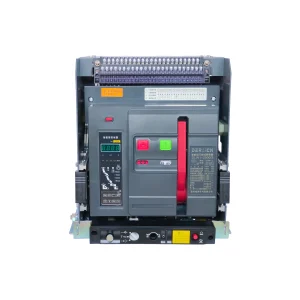

Rated Current (In) and Frame Size
The first step is determining the continuous current the breaker will carry. However, in the world of ACBs, the Frame Size (AF) is as important as the Rated Current (AT).
The Frame Size Advantage: A 2000A ACB might be available in a 2000A frame or a 3200A frame. Choosing the larger frame size provides better heat dissipation and often a higher breaking capacity, which is essential for “harsh” environments like tropical manufacturing sites or maritime engine rooms.
Future Expansion: If a facility expects to add more machinery in three years, selecting a larger frame size now allows for a simple “rating plug” swap later, rather than a costly replacement of the entire breaker and busbar structure.
Rated Short-Time Withstand Current (Icw)
This is arguably the most critical factor for an ACB, distinguishing it from an MCCB. Icw defines the breaker’s ability to remain closed during a high-magnitude fault for a specific duration (usually 1s or 3s).
Why it matters: In a main panel, you do not want the main ACB to trip instantly for a small fault on a branch circuit. You want the main breaker to “withstand” the fault current long enough to let the downstream branch breaker clear it.
Selection Logic: Ensure the Icw of your ACB is equal to or higher than the calculated prospective short-circuit current of the system to achieve Full Selectivity.
Breaking Capacity: Icu vs. Ics
As with all circuit breakers, understanding the “Ultimate” (Icu) and “Service” (Ics) breaking capacities is vital for safety and downtime management.
Industrial Standard: For high-current applications, always specify Ics=100% of Icu.
High-Fault Environments: If the ACB is located close to a high-capacity transformer (e.g., 2500kVA), the potential fault current is immense. A breaker with a high Icu (e.g., 85kA or 100kA) ensures that even a catastrophic short circuit is cleared safely.
Trip Unit Functionality (LSIG Protection)
Modern ACBs use sophisticated electronic trip units. For high-current main breakers, standard “Overload” protection is insufficient. You must consider the LSIG parameters:
L (Long-time): Protection against sustained overloads.
S (Short-time): Delayed short-circuit protection for selectivity.
I (Instantaneous): Immediate trip for massive short circuits.
G (Ground Fault): Protection against insulation failure. This is often mandatory for systems over 1000A to prevent fires caused by “arcing” ground faults.
Technical Tip: In environments with heavy harmonics (like VFD-heavy factories), ensure the trip unit is True RMS sensing to prevent nuisance tripping caused by “dirty” power.
Installation Type: Fixed vs. Draw-out
How the ACB is mounted affects the maintenance cost and downtime of the entire facility.
Fixed Type: The breaker is bolted directly to the busbars. It is more cost-effective but requires a total system shutdown for maintenance or replacement.
Draw-out Type: The breaker sits on a cradle and can be “racked out” for service while the rest of the switchgear remains live.
Essential for: Data centers, hospitals, and continuous manufacturing where a 4-hour shutdown for maintenance is not an option.
Installation Type: Fixed vs. Draw-out
| Feature | Standard Industrial | Mission-Critical / Maritime |
|---|---|---|
| Current Range (In) | 800A – 4000A | 1600A – 6300A |
| Breaking Capacity (Ics) | 50%−75%Icu | 100%Icu |
| Protection Type | LSI | LSIG (with Earth Fault) |
| Icw (1s) | 42kA – 65kA | 85kA – 100kA+ |
| Mounting | Fixed or Draw-out | Draw-out (Mandatory) |
| Communication | Optional | Required (Modbus/Ethernet) |
Frequently Asked Questions (FAQs)
1. Can an ACB be used for DC applications?
Most standard ACBs are designed for AC. For high-current DC systems (like solar farms or battery storage), you must select a specialized DC ACB with arc chutes designed for the unique challenges of extinguishing a DC arc.
2. How does ambient temperature affect ACB selection?
ACBs are typically calibrated for 40°C. In high-temperature regions or cramped maritime engine rooms, you must derate the current carrying capacity. For example, a 2000A ACB may only be able to carry 1800A safely at 50°C.
3. What is the difference between a 3-pole and 4-pole ACB?
A 4-pole ACB switches the neutral conductor. This is essential in systems where you need to isolate the neutral for safety or where ground fault protection schemes require a dedicated neutral pole to monitor unbalanced currents.
Conclusion
Selecting the right ACB is an exercise in engineering foresight. By prioritizing Icw for selectivity, ensuring LSIG protection, and choosing the right installation type, you create a power distribution “heart” that is resilient to both technical faults and operational demands.
Always ensure your selected ACB carries the necessary CE, IEC 60947-2, or maritime certifications (like BV or CCS) to guarantee performance in the field.
Expert Support for Your High-Current Projects Building a main distribution panel or upgrading a maritime power system? Our team provides high-performance, certified ACBs with full technical documentation to ensure your project meets the highest global standards.
Would you like me to help you generate a technical specification comparison between two specific ACB series for your next project proposal?
[Contact our export team for technical documentation or a custom quote for your next project.]
Table of Contents
Have you Any Questions?
Can’t find an answer to your question, or want more information about our products? If so, please feel free to get in touch with our professional team. We’re here to help you drive your projects to success.