
In the fast-paced world of industrial infrastructure, the “time-to-market” for a project is often dictated by the slowest-moving component in the supply chain. For procurement managers and lead engineers, sourcing electrical components is traditionally a fragmented process—buying MCCBs from one vendor, ATS units from another, and stabilizers from a third.
However, a shift toward One-Stop Procurement—specifically sourcing from a centralized factory hub—is redefining industrial efficiency. This guide explores the technical and logistical advantages of consolidating your electrical supply chain within a high-density manufacturing cluster.
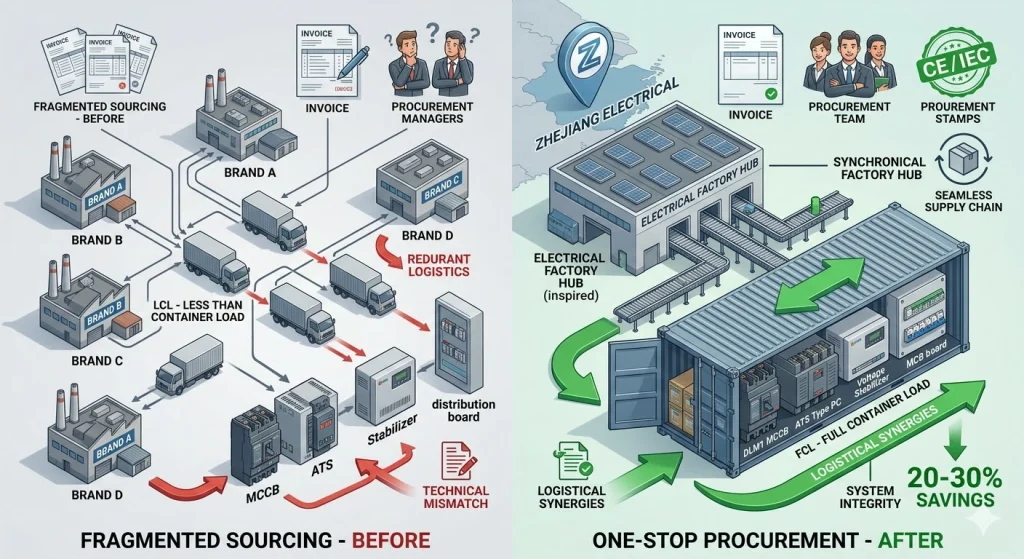
One-Stop Procurement: Why Sourcing Electrical Components from a Factory Hub is More Efficient
In industrial electrical engineering, the “total cost of ownership” is not just the price on an invoice. It includes the cost of lead times, the risk of technical incompatibility, and the administrative burden of managing multiple certifications.
When you source from a Factory Hub—such as the massive electrical clusters in the Zhejiang province—you aren’t just buying parts; you are tapping into a specialized ecosystem. Here is why the “One-Stop” model is superior for modern power distribution projects.
Logistical Synergies and "The Container Effect"
The most immediate benefit of one-stop procurement is the dramatic reduction in landed costs through logistical consolidation.
Consolidated Shipping
In a fragmented model, you might pay for three separate LCL (Less than Container Load) shipments from three different cities. In a hub-based model, your MCCBs, ATS units, and distribution boards are manufactured within the same 50km radius.
Efficiency Gain: These can be consolidated into a single FCL (Full Container Load), reducing freight costs by 20–30% and significantly lowering the risk of port delays.
Reduced Lead Times
Factory hubs operate on a “Just-in-Time” basis with their own sub-suppliers. If a specific component for a 4-pole ATS is needed, it is likely available from a neighboring factory within hours, not weeks.
Technical Compatibility and System Integrity
A common nightmare for site engineers is discovering that an MCCB from “Brand A” does not physically or electrically align with the busbars or accessories of “Brand B.”
Physical Integration
By sourcing from a single hub or integrated manufacturer, you ensure that the dimensions, mounting brackets, and terminal spacings follow a unified design philosophy. This is critical for:
Accessory Fit: Shunt trips, auxiliary contacts, and motor operators are guaranteed to seat correctly within the breaker frames.
Busbar Alignment: Ensuring that the phases align perfectly in a modular distribution board, reducing the need for on-site “hacking” or custom copper work.
Electrical Coordination
When breakers and transfer switches are engineered in the same ecosystem, manufacturers can provide pre-verified coordination tables. This means you know exactly how the upstream MCCB will react to a fault cleared by a downstream MCB, ensuring total selectivity.
Simplified Compliance and Technical Documentation
For projects in regulated markets (like East Africa, the UAE, or Europe), the paperwork is as important as the hardware.
Unified Technical Files: Instead of chasing five different manufacturers for CE (LVD/EMC) or IEC test reports, a one-stop source provides a single, organized technical dossier.
Consistent Certification: It is easier to verify the authenticity of certificates (like TUV or Intertek) when they are issued for a cohesive range of products from a known manufacturing cluster.
Customs Smoothness: A single Bill of Lading and a single Certificate of Origin simplify the customs clearance process, particularly in regions with strict “Pre-Export Verification of Conformity” (PVoC) requirements.
Enhanced Technical Support and "Single Point of Truth"
When an issue arises on a job site—such as a mysterious voltage fluctuation or a nuisance trip—the “blame game” between vendors can stall a project for months.
The Advantage of One Source: With one-stop procurement, you have a single technical team accountable for the entire power string. If an ATS isn’t communicating with a stabilizer, the manufacturer cannot point the finger at a third party; they must provide a solution.
Engineering Expertise
Hub-based manufacturers often have deep expertise in “tropicalization” or specialized maritime standards because they produce these variations at scale for a global clientele. This collective knowledge is available to you as a single consulting resource.
Global Resilience: The "Wildcard" Benefit
In an era of geopolitical shifts and supply chain disruptions, sourcing from a major hub provides a layer of industrial resilience. If one factory in the cluster faces a local power restriction or material shortage, the proximity of dozens of other specialized manufacturers allows the hub to pivot and maintain production.
This “cluster effect” ensures that your project remains on track even when global supply chains are under pressure.
Selection Guidance: How to Find a Reliable Hub Partner
To maximize the benefits of the one-stop model, look for partners who offer:
A Broad Product Range: Look for manufacturers who produce everything from the Main Breaker (MCCB) to the Final Distribution (MCB) and Power Conditioning (Stabilizers).
Verified Certificates: Ensure their entire range is CE/IEC certified under the same parent company or group.
OEM/ODM Capability: A true hub partner can customize components to your specific regional requirements (e.g., specific voltage ranges for East African grids).
Consolidation Services: They should have the warehouse capability to hold different parts of your order and ship them together.
Conclusion
One-stop procurement is more than a convenience; it is a strategic advantage. By sourcing from a concentrated electrical factory hub, you eliminate the technical friction of mismatched components, slash your logistical overhead, and gain a technical partner that understands the entire lifecycle of your power system.
In the competitive landscape of 2026, the most successful projects aren’t just built with the best parts—they are built with the most efficient supply chains.
Streamline Your Next Project Today Are you looking to consolidate your electrical sourcing and reduce project lead times? Our factory hub in Zhejiang offers a complete range of certified MCCBs, ATS units, and stabilizers, all backed by a single technical support team.
[Request a Consolidated Product List or a Technical Consultation Today]
Table of Contents
Have you Any Questions?
Can’t find an answer to your question, or want more information about our products? If so, please feel free to get in touch with our professional team. We’re here to help you drive your projects to success.