Hidden Costs: How Poor Power Quality is Killing Your Factory’s Productivity
In the modern manufacturing landscape, profitability is often a game of margins. While factory managers meticulously track labor costs and raw material waste, an “invisible tax” is often being paid directly to the utility grid. This tax is the result of poor Industrial Power Quality.
In my decade of overseeing electrical production and advising on industrial infrastructure, I have observed that the most dangerous power issues are not the total blackouts. Instead, they are the subtle Voltage Sag Mitigation failures and harmonic instabilities that occur while the machines are still running. These issues do not just stop production; they degrade your assets from the inside out.
The Financial Drain: Three Ways Poor Power Impacts the Bottom Line
When the electrical supply deviates from a clean, stable sine wave, the consequences ripple through every department of a facility.
Unexpected Equipment Downtime
The most immediate cost of poor power is a sudden “trip.” Modern Industrial Automation systems, specifically PLC controllers and variable frequency drives (VFDs), are highly sensitive. A voltage drop lasting only 100 milliseconds can cause a logic error, halting a multi-stage production line. The cost is not just the 10 minutes to reset the machine, but the hours required to clear the line and recalibrate the system.
Premature Component Failure
Electrical motors and electronic PCBs are designed for a specific voltage range. Chronic Harmonic Distortion and low voltage force motors to draw more current to maintain torque, leading to excessive heat. This heat bakes the internal insulation, turning a 15-year motor lifespan into a 5-year replacement cycle. These are “hidden” capital expenditures that most facilities fail to attribute to their power supply.
Product Quality and Wastage
In precision manufacturing—such as plastic injection molding or CNC machining—even a minor Transient Voltage Surges event can cause a deviation in tool pressure or heating temperature. This results in “batches from hell” where the final product fails quality control, wasting thousands of dollars in raw materials.
Identifying the Technical Culprits
To solve the problem, engineering teams must first categorize the disturbances entering the facility.
Voltage Sags and Swells
A sag is a short-duration reduction in voltage, often caused by the startup of heavy machinery elsewhere on the grid. Conversely, a swell is a brief increase. Without a dedicated Servo Voltage Regulator, these fluctuations force your equipment’s internal power supplies to work overtime, leading to eventual burnout.
Harmonic Distortion (THD)
Non-linear loads, such as LED lighting and large-scale VFDs, “pollute” the electrical network by reflecting high-frequency noise back into the system. This distortion causes “phantom” tripping of MCCBs and overheating of neutral conductors and transformers.
Transient Surges
Unlike a steady swell, a transient is a microsecond-long spike of high energy. These are often caused by grid switching or lightning. While an SPD (Surge Protective Device) handles the peak, only a comprehensive power conditioning strategy ensures that the “residual” energy doesn’t fry sensitive sensor arrays.
Strategic Solutions: Choosing the Right Industrial Stabilizer
For facilities in regions with unstable infrastructure, such as parts of East Africa or the Middle East, a robust Industrial Voltage Stabilizer is the primary defense. However, the technology must match the load.
| Feature | Relay Type | Servo Motor Type | Static (SCR) Type |
|---|---|---|---|
| Accuracy | ±8% to 10% | ±1% to 3% (Very High) | ±1% (Precision) |
| Response Speed | Fast (Relay Switching) | Slower (Physical Motor Move) | Instantaneous |
| Durability | Moderate (Moving Relays) | High (Robust Transformer) | Highest (Solid State) |
| Best Use Case | Small fridges, low-budget homes. | Double-door fridges, ACs, Whole-house. | Medical equipment, high-end labs. |
| IEC Compliance | Usually IEC 60947-1 | Strict IEC 60947 Compliance | High-end Industrial |
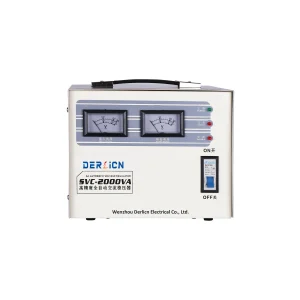
Servo Motor Type Voltage Regulator/Voltage Stabilizer
Manufacturer’s Insight: “From a factory’s perspective, always ensure your Power Factor Correction banks are installed downstream of your main stabilizer. If they are upstream, the high-frequency switching of capacitor banks can cause unnecessary mechanical wear on a servo-motor stabilizer’s carbon brushes, shortening your maintenance intervals.”
Frequently Asked Questions (FAQs)
Does a voltage stabilizer help with harmonic distortion? A standard voltage stabilizer is primarily designed for voltage regulation. While some advanced models include basic filtering, significant harmonic issues require active or passive harmonic filters to clean the current waveform.
How do I know if my factory has poor power quality? The most common signs are frequent, unexplained “reboots” of PLC systems, motors that run excessively hot, or a high failure rate of LED driver modules and power supplies.
What is the difference between a stabilizer and a UPS? A stabilizer corrects the voltage while the grid is on. A UPS (Uninterruptible Power Supply) provides battery backup when the grid fails. For heavy industrial machinery, a stabilizer is usually more cost-effective than a large-scale UPS.
Is it necessary to stabilize the entire factory or just specific machines? For cost-efficiency, many managers utilize “Point-of-Use” stabilization for sensitive CNC or robotic cells, while leaving “robust” loads like basic heating elements on the raw grid. However, for total system reliability, a main-line stabilizer is preferred.
What kVA capacity should I choose for my factory? You should calculate the total running load and add a safety margin of at least 30% to account for inrush currents. For inductive loads like motors, this margin may need to be even higher to prevent the stabilizer from tripping during startup.
Conclusion: Protect Your Cool
The “hidden” costs of poor electrical infrastructure can easily equal 5–10% of a factory’s annual turnover in the form of wasted labor, discarded materials, and premature equipment replacement. Transitioning to a proactive power management strategy is not merely an engineering preference; it is a fundamental requirement for any facility aiming for global competitiveness.
By implementing the right combination of Power Factor Correction and high-precision voltage regulation, you move from a reactive “repair” culture to a proactive “production” culture.
Optimize your factory’s output today. Our engineering team at Derlicn Electric specializes in designing high-capacity industrial power solutions tailored to the world’s most challenging electrical environments.
Would you like a customized technical consultation or a bulk quote for your facility’s power protection needs? Contact us today to speak with an industrial specialist.
Table of Contents
Have you Any Questions?
Can’t find an answer to your question, or want more information about our products? If so, please feel free to get in touch with our professional team. We’re here to help you drive your projects to success.