
Indoor vs. Outdoor Vacuum Circuit Breakers (VCB): Environmental Factors That Dictate Your Choice
In the world of Medium Voltage (MV) distribution—typically ranging from 12kV to 40.5kV—the Vacuum Circuit Breaker (VCB) is the undisputed industry standard. Its ability to quench an arc within a vacuum interrupter makes it exceptionally reliable and virtually maintenance-free.
However, a VCB is only as good as its housing. Choosing between an Indoor VCB and an Outdoor VCB is not just a matter of where you bolt it down; it is a decision governed by the physics of insulation, environmental degradation, and the rigors of the local climate.
The core technology of a VCB—the Vacuum Interrupter (VI)—is essentially the same whether it sits inside a climate-controlled data center or on a utility pole in a tropical monsoon region. The “vacuum” provides a dielectric strength far superior to air, allowing for a compact design and rapid arc extinction.
The real difference lies in the External Insulation and the Mechanism Housing. Here are the five environmental factors that must dictate your procurement choice.
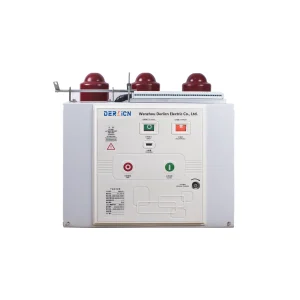
Indoor Vacuum Circuit Breaker
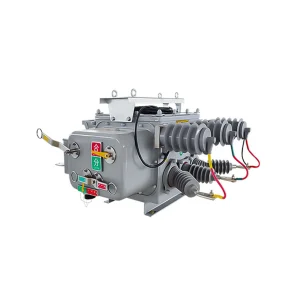
Outdoor Vacuum Circuit Breaker
Ingress Protection (IP Rating) and Enclosure Design
The most obvious distinction is how the device fights the entry of foreign objects and moisture.
Indoor VCB: Designed to be installed inside a Metal-Clad Switchgear panel (such as the KYN28 series). Since the panel provides the primary protection, the breaker itself usually has a lower IP rating (often IP2X or IP3X). It relies on the building’s HVAC or the panel’s internal space heaters to remain dry.
Outdoor VCB: These are “stand-alone” units. Whether they are pole-mounted or substation-mounted, they must feature a weather-proof enclosure, typically IP65 or higher. The housing is made of corrosion-resistant materials like high-grade stainless steel or powder-coated galvanized steel to withstand rain, snow, and wind-driven dust.
Creepage Distance and Pollution Levels
Outside the safety of a switchgear room, “pollution” (dust, salt spray, or industrial chemicals) settles on the insulating surfaces. When combined with moisture, this creates a conductive path that can lead to “tracking” or a catastrophic flashover.
Creepage Distance: This is the shortest distance along the surface of the insulation between two conductive parts.
The Outdoor Solution: Outdoor VCBs utilize insulators with “fins” or “petticoats” (often made of Silicone Rubber or Porcelain). These fins increase the creepage distance significantly without making the breaker excessively tall.
Selection Logic: In coastal areas or heavy industrial zones (high salinity/pollution), an outdoor VCB must be specified with a high specific creepage distance (e.g., 31mm/kV) to prevent leakage currents.
Humidity, Condensation, and Tropicalization
In many emerging markets—particularly in East Africa or Southeast Asia—high humidity is a constant threat.
The Condensation Trap: When temperatures drop at night, moisture condenses on the cold metal parts of the breaker mechanism. This leads to rust in the springs and linkages, causing the breaker to become “sluggish” or fail to trip.
Indoor Requirement: Indoor panels require active anti-condensation heaters.
Outdoor Requirement: Outdoor VCBs often come with “tropicalized” mechanisms. This involves using specialized lubricants that don’t degrade in high humidity and ensuring all internal control circuits are treated with anti-fungal, moisture-proof coatings.
UV Radiation and Material Integrity
Sunlight is a silent killer of electrical insulation.
Indoor VCBs often use Epoxy Resin for their primary insulation. Epoxy is excellent for indoor use due to its mechanical strength, but it degrades and “chalks” when exposed to Ultraviolet (UV) radiation.
Outdoor VCBs must use UV-stable materials. Hydrophobic Cycloaliphatic Epoxy (HCEP) or Silicone Rubber are the preferred choices. These materials maintain their dielectric properties and “water-shedding” ability even after years of direct exposure to intense equatorial sunlight.
Maintenance Accessibility and Operational Life
Indoor VCB (Draw-out Type): These are usually mounted on a truck (cradle). Maintenance is easy: you simply “rack out” the breaker and service it in a clean environment. This is ideal for facilities where downtime is expensive.
Outdoor VCB: Maintenance often requires a bucket truck or a substation shutdown. Because they are harder to access, outdoor VCBs are engineered for higher mechanical endurance (often Class M2, up to 10,000 operations) to ensure they don’t need frequent intervention.
Technical Comparison Table
| Feature | Indoor VCB | Outdoor VCB |
|---|---|---|
| Standard | IEC 62271-100 | IEC 62271-100 |
| Typical Voltage | 12kV, 24kV, 36kV | 12kV, 24kV, 33/36kV, 40.5kV |
| Insulation Material | Epoxy Resin | Silicone Rubber / HCEP / Porcelain |
| IP Rating | IP2X to IP4X | IP55 to IP67 |
| Creepage Distance | Standard (Low) | High (Petticoat design) |
| Mounting | Fixed or Draw-out (in panel) | Pole-mounted or Pedestal |
| Environmental Threat | Dust, rodents | Rain, UV, Salinity, Ice |
Conclusion
The choice between an indoor and outdoor VCB is ultimately a map-based decision. If you are designing a compact urban substation with limited footprint, an Indoor VCB inside a GIS (Gas Insulated Switchgear) or AIS (Air Insulated Switchgear) panel is the professional choice.
However, for rural electrification, mining operations, or coastal distribution networks where building a dedicated switchgear room is cost-prohibitive, a robust, UV-stabilized Outdoor VCB is the only way to ensure long-term grid stability.
Always consult the IEC 62271-100 standards to ensure your selected breaker’s “service conditions” (altitude, temperature, and pollution level) match the reality of your installation site.
Reliable Power in Any Climate Are you looking for high-performance VCBs for your next project? Whether it’s a 12kV indoor unit for a commercial complex or a 36kV outdoor breaker for an East African energy grid, we provide certified solutions backed by comprehensive technical documentation.
[Contact our export team for technical documentation or a custom quote for your next project.]
Table of Contents
Have you Any Questions?
Can’t find an answer to your question, or want more information about our products? If so, please feel free to get in touch with our professional team. We’re here to help you drive your projects to success.