In the contemporary landscape of residential infrastructure, the sophistication of electronic loads has increased exponentially. From high-efficiency HVAC systems with variable-frequency drives (VFDs) to sensitive smart-home servers and medical-grade home care equipment, the demand for “clean” power is at an all-time high. A home voltage stabilizer, technically known as an Automatic Voltage Regulator (AVR), is a critical power conditioning device designed to deliver a constant voltage to a load even when the input utility voltage fluctuates.
For electrical engineers and contractors, understanding the nuances of voltage stabilization is not merely about preventing equipment failure; it is about optimizing system efficiency and adhering to power quality standards such as IEC 60038. This guide provides an in-depth technical analysis of voltage stabilizers, their internal architecture, and their role in modern power distribution.
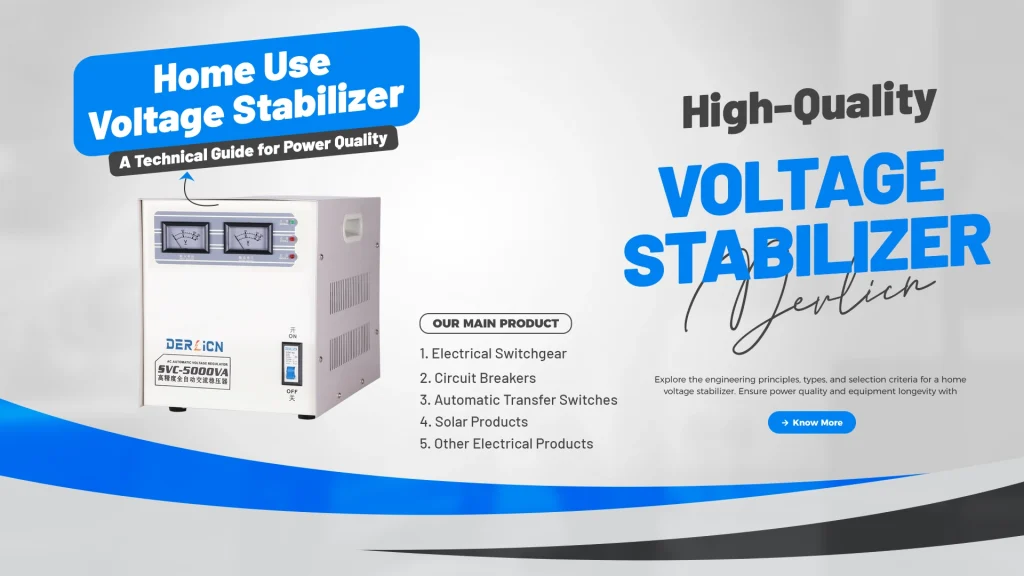
What is a Home Voltage Stabilizer?
A home voltage stabilizer is an electromechanical or static device used to maintain a stable voltage level at the output, regardless of changes in the input voltage or load conditions. Its primary function is to protect electrical appliances against “sags” (under-voltage) and “swells” (over-voltage).
In most regions, the nominal utility voltage is standardized (e.g., 230V AC in Europe/Asia or 120V AC in North America). However, due to grid instability, poor distribution infrastructure, or heavy industrial loads nearby, the actual voltage delivered to a residence can vary by ±20% or more. A stabilizer acts as a buffer, ensuring the output remains within a safe operating window—typically ±1% to ±5% of the nominal rating—thereby preventing insulation breakdown, overheating, and logic errors in microprocessor-controlled devices.
How Does a Home Voltage Stabilizer Work?
The fundamental principle of a voltage stabilizer is based on buck and boost operations. When the input voltage drops below a predefined threshold, the stabilizer “boosts” the voltage to the required level. Conversely, when the input voltage exceeds the threshold, it “bucks” or steps down the voltage.
The Feedback Loop Mechanism
Sensing: The control circuit continuously monitors the incoming utility voltage.
Comparison: The sensed voltage is compared against a reference voltage (the set point).
Correction: If an error signal is detected (the difference between actual and reference voltage), the control circuit triggers a correction mechanism.
Output: The modified voltage is delivered to the load.
In modern electronic stabilizers, this process happens in milliseconds. The correction is achieved by varying the transformer turns ratio. By changing the taps on an autotransformer or by using a secondary buck-boost transformer in series with the main supply, the device adds or subtracts voltage to maintain equilibrium.
Main Components of a Home Voltage Stabilizer
To appreciate the reliability of these devices, one must examine the internal components that facilitate precise regulation.
1. Transformer
The heart of any stabilizer is the transformer. Depending on the design, it may use:
- Autotransformer: A single-winding transformer where the primary and secondary share a common connection, allowing for compact size and high efficiency.
- Buck-Boost Transformer: Used in high-capacity stabilizers to provide the necessary additive or subtractive voltage.
2. Control Circuitry
The “brain” of the unit. In legacy models, this was an analog comparator circuit. Modern units utilize Microcontrollers (MCUs) or Digital Signal Processors (DSPs). These digital controllers offer:
- True RMS sensing.
- Programmable delay timers.
- High-speed switching logic.
3. Switching Mechanism
This determines how the transformer taps are changed.
- Relays: Used in budget-friendly, low-power applications.
- Servo Motors: Used for continuous, high-precision adjustment.
- Solid-State Switches (SCRs/Triacs/IGBTs): Used in static stabilizers for near-instantaneous correction with no moving parts.
4. Protection Suite
Industrial-grade home stabilizers include:
- Thermal Overload Protection: Using thermistors to monitor winding temperature.
- Surge Arrestors (MOVs): To shunt high-voltage transients from lightning or grid switching.
- Circuit Breakers/Fuses: For short-circuit protection.
Types of Home Voltage Stabilizers
Choosing the right technology is essential for matching the stabilizer to the load’s sensitivity.
1. Relay-Type Voltage Stabilizers
These rely on electromagnetic relays to switch between different taps of an autotransformer.
- Pros: Low cost, compact, highly efficient at nominal voltages.
- Cons: Discrete voltage steps (not continuous), mechanical wear of relay contacts, and slower response times (approx. 10–20ms).
- Best For: General household appliances like refrigerators and televisions.
2. Servo-Controlled Voltage Stabilizers
These utilize a servo motor to move a carbon brush along the windings of a toroidal autotransformer (Variac).
- Pros: Extremely high precision (±1% accuracy), smooth continuous voltage correction, and high surge current handling.
- Cons: Slower correction speed (approx. 20–50V/sec) compared to electronic types, requires periodic maintenance of carbon brushes.
- Best For: Entire house protection, expensive audio-visual setups, and air conditioning units.
3. Static Voltage Stabilizers
The most advanced category, static stabilizers use power electronics (IGBTs) and Pulse Width Modulation (PWM) to regulate voltage.
- Pros: No moving parts, silent operation, ultra-fast correction (within 1 cycle), and extremely high reliability.
- Cons: Higher initial capital expenditure.
- Best For: Sensitive medical equipment, high-end server racks, and luxury residences in areas with extreme voltage volatility.
Applications of a Home Voltage Stabilizer
While a stabilizer can be used for any electrical device, its application is critical in the following scenarios:
- HVAC Systems: Air conditioners are highly susceptible to voltage drops, which cause increased current draw and subsequent compressor motor burnout.
- Refrigeration and Pumping: Induction motors require a specific torque-to-speed ratio, which is compromised by poor voltage, leading to inefficiency and overheating.
- Home Automation and IT: Smart home hubs and NAS (Network Attached Storage) systems can suffer data corruption if the supply voltage fluctuates outside the narrow tolerances of their internal Power Supply Units (PSUs).
- Electric Vehicle (EV) Charging: Residential EV chargers often require stable voltage to maintain the handshake protocol with the vehicle’s Battery Management System (BMS).
Advantages of a Home Voltage Stabilizer
Integrating a voltage stabilizer into a residential power distribution system offers several technical and financial benefits:
- Extended Equipment Lifespan: By preventing thermal stress on insulation and electronic components, stabilizers significantly reduce the MTBF (Mean Time Between Failures) of household assets.
- Energy Efficiency: Appliances operating at their design voltage run at peak efficiency. Under-voltage, for instance, forces motors to draw more current to maintain torque, leading to I2R losses (heat).
- Fire Safety: Persistent over-voltage can lead to the breakdown of insulation materials, which is a leading cause of electrical fires in residential settings.
- Operational Continuity: Avoids nuisance tripping of sensitive internal protection circuits in high-end electronics.
How to Choose the Right Home Voltage Stabilizer
For contractors and engineers, selecting a stabilizer requires a systematic calculation of the load and environmental factors.
1. Calculate the Total Load (kVA Rating)
Sum the wattage of all appliances to be connected. Apply a safety margin of at least 20–30% to account for future expansion and “inrush” currents (starting currents of motors).
2. Determine the Input Voltage Range
Analyze local grid history. If the voltage frequently drops to 160V, you need a stabilizer with a wide input window (e.g., 140V–280V). Selecting a narrow-range stabilizer in a volatile area will result in the device frequently cutting off the power to protect itself.
3. Response Time and Precision
For purely resistive loads (lighting, heating), a relay stabilizer is sufficient. For inductive loads or sensitive electronics, a servo or static stabilizer with a precision of ±1% to ±3% is recommended.
4. Protection Features
Ensure the unit carries relevant certifications (IEC 61000 for electromagnetic compatibility or UL 1012). Look for features like “High-Voltage Cutoff,” “Short-Circuit Protection,” and “Time Delay” (which protects compressors by allowing pressure equalization after a power cut).
Common FAQs
Q1: Can a voltage stabilizer also act as a surge protector?
Most high-quality stabilizers include basic surge protection (MOVs), but they are primarily designed for steady-state regulation. For lightning-level transients, a dedicated Type 2 Surge Protection Device (SPD) should be installed in the main distribution board.
Q2: Is a stabilizer necessary if I have a UPS?
An Online Double-Conversion UPS provides the best voltage regulation. However, for large loads like air conditioners, a UPS is cost-prohibitive. In such cases, a stabilizer is the most economical solution for power quality.
Q3: Does a voltage stabilizer consume a lot of electricity?
Modern stabilizers are highly efficient, typically between 95% and 98%. The energy saved by allowing your appliances to run at their optimal voltage often offsets the small idle power consumption of the stabilizer.
Q4: Can I use one stabilizer for the whole house?
Yes, “Mainline” or whole-house stabilizers are designed for this. They are installed immediately after the energy meter and protect all downstream circuits. These are usually servo-controlled or static types due to the high kVA requirements.
Q5: How long does a typical home voltage stabilizer last?
A well-maintained servo stabilizer can last 10–15 years, while static stabilizers can exceed 20 years due to the lack of mechanical wear. Relay types may require relay replacement every 5–7 years depending on the frequency of switching.
Conclusion
As residential electrical systems become more complex, the role of the home voltage stabilizer evolves from a luxury to a technical necessity. For electrical engineers and project managers, specifying the correct stabilization technology—whether it be relay, servo, or static—is a fundamental step in ensuring system reliability and client satisfaction. By mitigating the risks of grid instability, you not only protect expensive hardware but also optimize the energy footprint of the modern home.
When selecting a stabilizer, always prioritize units that adhere to international safety standards and offer comprehensive protection suites. A robust power quality strategy is the foundation of any resilient electrical installation.
Table of Contents
Have you Any Questions?
Can’t find an answer to your question, or want more information about our products? If so, please feel free to get in touch with our professional team. We’re here to help you drive your projects to success.