In the field of electrical engineering and industrial power distribution, the integrity of a system is only as strong as its weakest conductor. To choose the right wire gauge is one of the most fundamental yet critical decisions an electrical contractor or system integrator can make. Selecting an undersized wire leads to excessive heat generation, significant voltage drops, and potential fire hazards, while over-sizing leads to unnecessary material costs and installation difficulties in conduits.
This guide provides a comprehensive technical breakdown of wire gauge selection, adhering to industry standards such as the National Electrical Code (NEC) and IEC 60228, ensuring your projects are safe, efficient, and compliant.
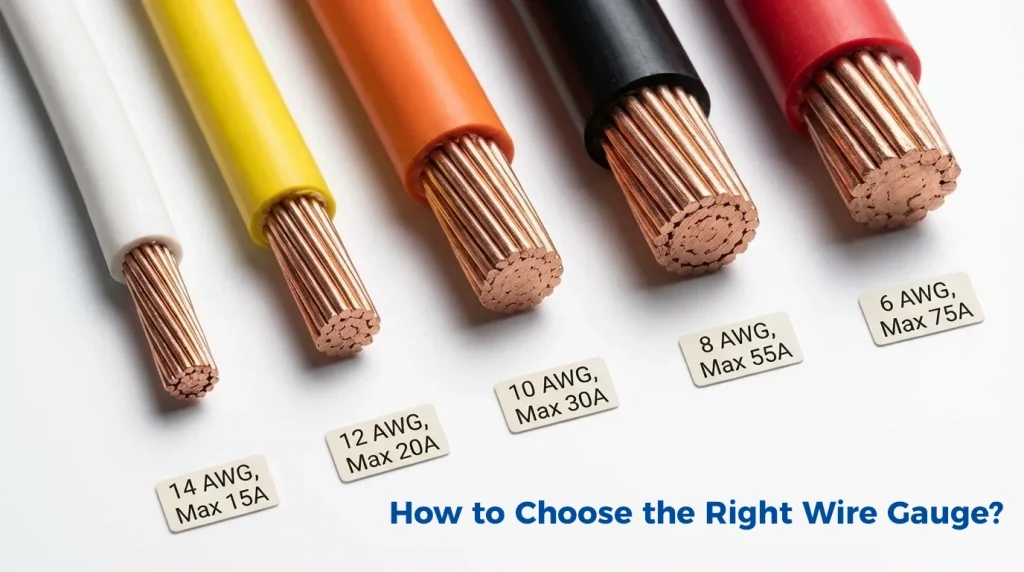
What is Wire Gauge?
Wire gauge is a standardized unit of measurement used to define the diameter and cross-sectional area of an electrical conductor. In North America, the American Wire Gauge (AWG) system is the predominant standard. In this inverse logarithmic scale, a smaller AWG number represents a larger wire diameter. For example, a 0000 AWG (4/0) wire is significantly thicker and carries more current than a 14 AWG wire.
Internationally, and specifically within the IEC framework, wire size is typically expressed in square millimeters (mm2). Regardless of the unit, the gauge determines two primary physical properties: electrical resistance and current-carrying capacity (ampacity).
How Does Wire Gauge Work?
The physics of wire gauge selection is governed by Ohm’s Law and the principles of thermodynamics. Every conductor has an inherent resistance (R), which is a function of the material’s resistivity (ρ), its length (L), and its cross-sectional area (A).
The Resistance Formula
When current (I) flows through a conductor, energy is dissipated as heat, a phenomenon known as Joule heating or I2R loss. To choose the right wire gauge, an engineer must ensure the cross-sectional area (A) is large enough that the resistance (R) does not cause the wire’s temperature to exceed the rating of its insulation.
Voltage Drop
As the distance (L) increases, the cumulative resistance causes a “voltage drop.” For sensitive electronic loads or high-power industrial motors, a voltage drop exceeding 3% can lead to equipment malfunction or premature motor failure. Choosing a thicker gauge (increasing A) is the primary method to mitigate this drop.
Main Components of a Wire Gauge System
When evaluating a wire for a project, the “gauge” is only one part of the specification. The following components interact with the gauge to determine performance:
Conductor Material: * Copper (Cu): The industry standard due to its high conductivity.
Aluminum (Al): Offers a better strength-to-weight ratio and lower cost but requires a larger gauge (typically two sizes larger) than copper to match the same ampacity.
Insulation Type: The gauge determines the volume of metal, but the insulation (e.g., THHN, XHHW, RHW) determines the maximum allowable operating temperature (usually 60°C, 75°C, or 90°C).
Core Construction: Whether the conductor is a single solid piece or composed of multiple small strands.
Types of Wire Gauge Configurations
Depending on the mechanical and electrical requirements of your project, the physical configuration of the gauge changes.
1. Solid Wire
Consists of a single strand of metal.
Best For: Permanent, stationary installations like residential wall wiring or busbars.
Characteristics: Lower surface area, less flexible, but highly resistant to environmental corrosion.
2. Stranded Wire
Consists of many small-gauge wires twisted together to achieve the desired total cross-sectional area.
Best For: Industrial machinery, robotics, and vehicle wiring where vibration or frequent movement is present.
Characteristics: High flexibility and better performance in high-frequency applications due to the reduction of the “skin effect.”
3. Multi-Conductor Cables
These combine several gauged wires within a single jacket (e.g., 12/2 Romex or 4-core industrial control cables). When sizing these, you must account for “bundling derating factors,” as multiple heat-producing wires in one jacket cannot dissipate heat as effectively.
Applications of Different Wire Gauges
To choose the right wire gauge, it is helpful to look at standard industry applications:
| AWG Size | Typical Application | Common Circuit Amperage |
|---|---|---|
| 18 AWG | Low-voltage lighting, thermostats, signal wires | 5A - 10A |
| 14 AWG | Residential lighting circuits, low-power outlets | 15A |
| 12AWG | Kitchen outlets, small power tools, 120V circuits | 20A |
| 10 AWG | Electric water heaters, window AC units | 30A |
| 6 AWG | Electric ranges, high-power HVAC compressors | 50A - 60A |
| 2 AWG - 4/0 | Main service entrances, industrial sub-panels | 00A - 200A |

Advantages of Choosing the Correct Wire Gauge
Fire Prevention: Properly sized conductors stay within their thermal limits, preventing insulation melting and arc faults.
Equipment Efficiency: Minimizing voltage drop ensures that motors and power supplies receive the specific voltage they were engineered to handle, reducing I2R losses within the equipment itself.
Regulatory Compliance: Using the correct gauge ensures your project passes inspections under NEC Table 310.16 or local building codes.
Future Proofing: Sizing a wire slightly above the current demand allows for future load expansion without rewiring.
How to Choose the Right Wire Gauge: A Step-by-Step Guide
For professional projects, follow this technical workflow to determine the optimal size.
Step 1: Calculate the Total Continuous Load
Identify the maximum current (I) the circuit will carry. For continuous loads (running for 3 hours or more), the NEC requires the conductor to be sized at 125% of the load.
Step 2: Account for Ambient Temperature
Conductor ampacity charts are typically rated for an ambient temperature of 30°C (86°F). If your wiring is in a hot attic or near industrial furnaces, you must apply a derating factor.
Example: A wire rated for 30A at 30°C might only safely carry 22A at 50°C.
Step 3: Calculate Voltage Drop for Long Runs
For runs longer than 50–100 feet, use the following formula to ensure the drop is below 3%:
(Where L is one-way length in feet, R is resistance per 1000ft from AWG tables, and I is current). If Vdrop is too high, move to the next larger wire gauge and recalculate.
Step 4: Verify Conduit Fill
If you are pulling multiple gauged wires through a single conduit, ensure you do not exceed 40% fill capacity (per NEC Chapter 9, Table 1) to allow for adequate airflow and heat dissipation.
Common FAQs
Q1: Can I use a larger wire gauge than required? Yes. Using a larger gauge (e.g., using 10 AWG for a 20A circuit) is electrically safe and improves efficiency by reducing resistance. The only downsides are increased cost and the physical difficulty of fitting thicker wire into terminal blocks.
Q2: What happens if I use a 14 AWG wire on a 20A breaker? This is a serious code violation. The 20A breaker will allow 20A to flow, but the 14 AWG wire is only rated for 15A. The wire will overheat and could start a fire before the breaker ever trips.
Q3: Is the gauge different for AC vs. DC? The gauge selection based on ampacity is the same. However, voltage drop is much more critical in low-voltage DC systems (like 12V solar). A 2V drop on a 120V AC circuit is negligible (1.6%), but a 2V drop on a 12V DC circuit is catastrophic (16.6%).
Q4: How does insulation temperature (60°C vs 75°C vs 90°C) affect gauge choice? Higher-rated insulation allows the same gauge of copper to carry more current because the material can withstand more heat. However, you must also ensure the equipment terminals (breakers/lugs) are rated for that same temperature.
Q5: Why is aluminum wire often a larger gauge? Aluminum has roughly 61% of the conductivity of copper. To achieve the same resistance and heat dissipation, an aluminum conductor must have a larger cross-sectional area, resulting in a larger gauge number.
Expert Support for Your Wiring Infrastructure
Selecting the correct wire gauge is a critical technical step, but integrating those components into a high-performance power distribution system requires precision and the right hardware. At [Company Name], we specialize in high-conductivity copper and aluminum solutions designed to meet the most rigorous industrial standards, from IEC 60228 to UL 83. Whether you are scaling a modular data center or optimizing a commercial grid, our technical team is ready to assist you with custom ampacity calculations, ambient temperature derating analysis, and specialized cable selections tailored to your specific environment.
Contact our engineering department today for a project consultation or browse our comprehensive catalog of industrial-grade conductors to ensure your next installation is built on a foundation of safety, efficiency, and long-term reliability.
Conclusion
To choose the right wire gauge is to balance technical safety with economic efficiency. By calculating your continuous load, accounting for environmental derating, and verifying voltage drop for long distances, you ensure a robust electrical infrastructure that meets international standards. Whether you are an electrical contractor wiring a residential complex or a project manager overseeing an industrial power distribution hub, precise conductor sizing is the foundation of electrical reliability.
Table of Contents
Have you Any Questions?
Can’t find an answer to your question, or want more information about our products? If so, please feel free to get in touch with our professional team. We’re here to help you drive your projects to success.