
In the field of electrical engineering, a circuit breaker’s primary job is to interrupt the flow of electricity during a fault. While most users focus on the rated current (the “Amps”), the most critical factor for survival—both for the equipment and the facility—is the breaking capacity of circuit breakers.
When a short circuit occurs, the current can spike from a few hundred Amps to tens of thousands of Amps in milliseconds. The breaking capacity defines the maximum fault current that a breaker can safely interrupt without exploding, welding its contacts, or causing a fire. Under the international standard IEC 60947-2, this capacity is divided into two distinct ratings: Icu and Ics.
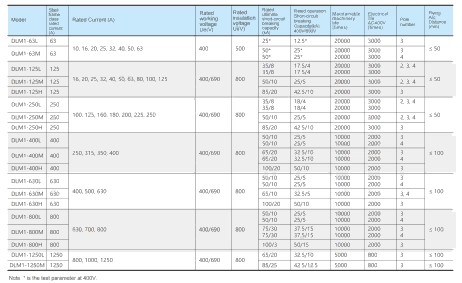
What is Breaking Capacity?
Breaking capacity is the highest level of fault current that a protective device can “break” (disconnect) at a specific voltage. When a breaker opens during a high-current fault, an electrical arc forms between the separating contacts. The breaker must be physically and thermally robust enough to quench this arc and withstand the massive mechanical stresses generated by the magnetic fields of the fault current.
The Physics of a Short Circuit
During a short circuit, the current is limited only by the impedance of the transformer and the cables. If a breaker with a 10kA breaking capacity is installed in a system where the potential fault current is 25kA, the breaker will likely fail catastrophically, potentially leading to an “arc flash” event.
Ultimate Short-Circuit Breaking Capacity (Icu)
The Icu is the maximum fault current the circuit breaker can interrupt at least once. It is the “ultimate” limit of the device’s capability.
The Icu Test Sequence
According to IEC 60947-2, the Icu is verified through a specific test sequence: O – t – CO.
O (Open): The breaker is closed, a fault is applied, and the breaker must trip and interrupt the fault.
t (Time interval): A short waiting period (usually 3 minutes) to allow the device to cool.
CO (Close-Open): The breaker is closed onto an existing fault. It must trip again immediately and interrupt the current.
Post-Test Condition
After an Icu event, the breaker is considered to have “sacrificed” itself. While it successfully protected the circuit, its internal contacts and arc chutes may be damaged. The standard does not guarantee that the breaker will be able to carry its rated current (In) continuously or trip accurately in the future. In professional practice, any breaker that has cleared a fault at or near its Icu rating should be replaced immediately.
Service Short-Circuit Breaking Capacity (Ics)
The Ics is perhaps the more important rating for industrial reliability. It represents the fault current the breaker can interrupt and still remain fully operational.
The Ics Test Sequence
The Ics test is more rigorous: O – t – CO – t – CO. The breaker must interrupt the fault current three times. Following this, the breaker is subjected to further tests to ensure it can still carry its full rated current and provide overload protection within the specified tolerances.
The Ics Ratio (k)
Manufacturers usually express Ics as a percentage of Icu (e.g., 25%, 50%, 75%, or 100%).
Ics=50%Icu: Common in standard commercial breakers.
Ics=100%Icu: The gold standard for industrial and mission-critical applications (Data centers, hospitals, heavy manufacturing).
Why the Difference Matters for Equipment Selection
Choosing a breaker based solely on Icu is a common cost-saving measure that can lead to high operational expenses in the long run.
Scenario: A Standard Factory Fault
Imagine a factory where the prospective short-circuit current is 30kA.
Option A: A breaker with Icu=36kA and Ics=50%(18kA).
Result: If a 25kA fault occurs, the breaker will clear it (since 25 < 36), but it must be replaced. Production stops until a spare is found and installed.
Option B: A breaker with Icu=36kA and Ics=100%(36kA).
Result: The same 25kA fault occurs. The breaker clears it, and after the fault is identified and fixed, the breaker can simply be reset. Production resumes immediately.
Recommendation: For main incoming breakers and critical branch circuits, always specify Ics=100%Icu.
Related Parameters: Icm and Icw
While Icu and Ics are the primary “breaking” ratings, two other parameters are vital for comprehensive system design.
Rated Short-Circuit Making Capacity (Icm)
Icm is the peak current the breaker can withstand when closing onto a fault. Because the peak current in the first half-cycle of a fault is much higher than the steady-state RMS current, the Icm must be significantly higher than the Icu.
Formula: Icm=n×Icu (where n is a factor defined by the IEC based on the power factor of the circuit).
Rated Short-Time Withstand Current (Icw)
This rating is primarily for “Category B” breakers (usually Air Circuit Breakers or large MCCBs). It defines the breaker’s ability to stay closed for a specific duration (e.g., 1 second) during a fault.
Purpose: This allows for Selectivity. It gives downstream branch breakers time to clear a local fault while the main breaker remains closed, preventing a total facility blackout.
How to Calculate the Required Breaking Capacity
To choose the right breaker, you must determine the Prospective Short-Circuit Current (Ipro) at the point of installation. This is influenced by:
Transformer Capacity: A 2000kVA transformer will deliver a much higher fault current than a 500kVA unit.
Distance from the Source: The resistance and reactance of the cables (impedance) reduce the fault current as you move further away from the transformer.
Utility Fault Level: The “strength” of the grid supply provided by the utility company.
Industry-Specific Selection Guidance
| Application | Recommended Ics Rating | Justification |
|---|---|---|
| Residential / Small Office | 25%−50%Icu | 25%−50%Icu Lower fault levels and lower cost sensitivity to downtime. |
| Manufacturing Plants | 75%−100%Icu | High cost of downtime; presence of large motors. |
| Data Centers / Hospitals | 100%Icu | Reliability is non-negotiable; safety-critical loads. |
| Maritime / Offshore | 100%Icu | Difficult to source replacements; harsh environment. |
Frequently Asked Questions (FAQs)
1. Where can I find the Icu and Ics on the breaker?
These are always printed on the front or side nameplate of the MCCB or ACB. They are usually listed in a table alongside different operational voltages (e.g., 230V, 400V, 690V).
2. Is breaking capacity the same as the trip setting?
No. The trip setting (e.g., 100A) is the current at which the breaker protects against overloads. Breaking capacity (e.g., 50kA) is the maximum “emergency” current it can stop during a short circuit.
3. What is the difference between Icu and Icn?
Icn is the term used in IEC 60898 (standard for residential/domestic MCBs). Icu is used in IEC 60947-2 (industrial standard). Generally, Icu testing is more rigorous than Icn.
4. Can I use a breaker with a lower Icu if I use “Cascading”?
Yes. “Cascading” or “Back-up Protection” allows a smaller downstream breaker to be rated for a lower fault current if an upstream breaker is designed to “assist” in clearing the fault. However, this may compromise selectivity.
Conclusion
The breaking capacity of circuit breakers is the ultimate insurance policy for an electrical system. While the Icu tells you the limit of safety, the Ics tells you the limit of operational continuity. For any industrial application where downtime equals significant financial loss, prioritizing a high Ics and ensuring proper coordination is the mark of professional engineering.
When reviewing your next request list or technical file, ensure that the Icu of the selected breakers exceeds the calculated fault current of your system by at least 10–20% to provide a safe engineering margin.
Maximize Your System Reliability Are you looking for high-performance MCCBs with Ics=100%Icu? Our engineering team provides detailed technical support to help you calculate fault levels and select the perfect protective devices for your infrastructure.
[Contact our Technical Team for a Specification Review or a Custom Quote Today]
Table of Contents
Have you Any Questions?
Can’t find an answer to your question, or want more information about our products? If so, please feel free to get in touch with our professional team. We’re here to help you drive your projects to success.