
Protecting Millions: Choosing the Right Medical Voltage Stabilizer for Sensitive Medical Equipment
In the high-stakes environment of a modern hospital, the margin for error is non-existent. While a factory might lose a batch of product due to a power flicker, a clinical facility risks something far more precious: patient safety. From the intricate circuitry of a neonatal ventilator to the massive superconducting magnets of an MRI suite, modern healthcare relies on a foundation of perfect electricity.
However, in many rapidly developing regions—from the high-demand grids of Sharjah to the expanding rural clinics in East Africa—the power supply is often precarious. For a biomedical engineer or hospital administrator, investing in a Medical Voltage Stabilizer is not merely a technical upgrade; it is a fundamental pillar of patient care.
The Vulnerability of Modern Diagnostic Imaging
Medical equipment is uniquely sensitive compared to industrial machinery. While a motor in a factory can tolerate a 5% voltage sag, the digital sensors in a 128-slice CT scanner cannot.
Precision Microprocessors
Most diagnostic tools utilize high-speed microprocessors that operate on low-voltage DC power. When the AC input fluctuates, the internal power supplies must work harder to compensate. Chronic instability leads to “Logic Errors” and software crashes, often occurring right in the middle of a critical patient scan.
Electromagnetic Noise and Image Quality
Poor Healthcare Power Quality often introduces high-frequency noise into the system. This “electrical pollution” manifests as artifacts or “snow” on ultrasound and X-ray images. For a radiologist, these artifacts can lead to a misdiagnosis, as they can obscure small lesions or mimic anatomical abnormalities.
3 Technical Signs Your Equipment is at Risk
If your facility is experiencing any of the following, your internal Hospital Power Infrastructure is failing to protect your assets.
Frequent Calibration Failures: Sensitive lab analyzers that require daily recalibration are often reacting to subtle voltage drifts.
“Ghost” Error Codes: If your nursing staff reports equipment rebooting without a clear cause, it is likely a transient voltage dip.
Overheating Transformers: If the back of your imaging console feels excessively hot, it is often a sign of Harmonic Mitigation issues or over-voltage stress.
Comparative Analysis: Selecting the Correct Stabilizer Technology
For medical applications, the choice of technology is dictated by the required “Response Speed” and “Accuracy.” A delay of even half a second can be too long for a digital X-ray machine.
| Feature | Relay Type | Servo Motor Type | Static (SCR) Type |
|---|---|---|---|
| Accuracy | ±8% to 10% | ±1% to 3% (Very High) | ±1% (Precision) |
| Response Speed | Fast (Relay Switching) | Slower (Physical Motor Move) | Instantaneous |
| Durability | Moderate (Moving Relays) | High (Robust Transformer) | Highest (Solid State) |
| Best Use Case | Small fridges, low-budget homes. | Double-door fridges, ACs, Whole-house. | Medical equipment, high-end labs. |
| IEC Compliance | Usually IEC 60947-1 | Strict IEC 60947 Compliance | High-end Industrial |
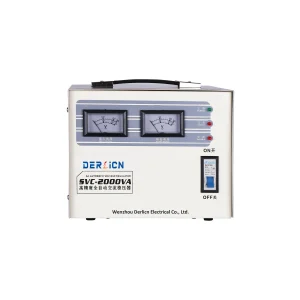
Servo Motor Type Voltage Regulator/Voltage Stabilizer
Manufacturer’s Insight: “In the medical sector, we strongly advise against using standard industrial stabilizers for imaging suites. A true Medical Voltage Stabilizer must include an integrated Isolation Transformer. This creates a ‘clean’ neutral and prevents ground-loop currents, which are the primary cause of signal interference in sensitive ECG and EEG monitors.”
Key Selection Factors for Clinical Environments
Response Time and Transient Suppression
Medical equipment experiences rapid load changes. An X-ray machine, for instance, draws a massive burst of current for only a fraction of a second. The stabilizer must be fast enough to prevent a voltage sag during this “pulse” without over-correcting and causing a spike.
Pure Sine Wave Output
Many budget stabilizers produce a “distorted” or “square” wave. This is fatal for medical electronics. High-tier stabilizers ensure a Pure Sine Wave, maintaining a Total Harmonic Distortion (THD) of less than 3%, which is essential for Biomedical Equipment Safety.
Frequently Asked Questions (FAQs)
Can I use a standard UPS instead of a medical stabilizer? While a UPS provides backup power, it does not always provide the high-precision regulation required for imaging. For the best protection, engineers often install a Static Voltage Stabilizer upstream of the UPS to ensure the batteries only engage during a total blackout, rather than every minor flicker.
Why is a CT scanner voltage regulator different from a normal one? CT scanners have a very high “peak demand” during the rotation of the gantry. A CT Scanner Voltage Regulator is specifically engineered to handle these high-current bursts without dropping the output voltage.
Does a stabilizer protect against lightning strikes? A stabilizer handles ongoing fluctuations, but it requires a dedicated Surge Protective Device (SPD) to stop a direct lightning strike. Most medical-grade units come with Class II SPDs pre-installed.
How does poor power affect MRI magnets? Inconsistent power can affect the cooling systems (chillers) of an MRI. If the cooling fails, the liquid helium can “quench,” leading to a catastrophic shutdown that costs tens of thousands of dollars to rectify.
What is the lifespan of a medical-grade stabilizer? When properly sized and maintained, a high-quality unit should provide Clinical Uptime for 15 to 20 years, outlasting many of the medical devices it protects.
Conclusion: The ROI of Patient Safety
The cost of a single Medical Voltage Stabilizer is negligible when compared to the multi-million dollar price tag of an MRI suite or the invaluable nature of human life. By stabilizing your Hospital Power Infrastructure, you reduce diagnostic errors, extend the life of your biomedical assets, and ensure that when a patient enters your facility, the technology is as ready as the medical staff.
Ensure your facility is protected against the unpredictable. Our factory specializes in the engineering and production of ultra-high-precision stabilized power solutions for the healthcare sector, meeting all international standards for medical electrical safety.
Would you like a technical consultation or a bulk quote for your hospital’s power protection project?
[Contact our specialized medical-power team today for a customized solution.]
Table of Contents
Have you Any Questions?
Can’t find an answer to your question, or want more information about our products? If so, please feel free to get in touch with our professional team. We’re here to help you drive your projects to success.