
Air Conditioner Not Cooling? Why a AC Voltage Stabilizer is the Missing Link
It is the peak of summer. The outside temperature is climbing past 45°C, and you retreat indoors for relief. You set your air conditioner to 18°C, but an hour later, the room is still stifling. The fan is blowing, but the air isn’t cold.
Your first instinct might be to call a technician to “top up the gas” (refrigerant). However, in my 10 years as a power quality consultant, I have found that in over 40% of cases in regions like the Middle East, Southeast Asia, and Africa, the problem isn’t the coolant—it’s the electricity.
If your AC isn’t cooling, the “missing link” is often a dedicated AC voltage stabilizer. Without a stable supply of power, your expensive HVAC system is essentially a very loud, very expensive desktop fan.
The Science of Cooling: Why Voltage is the "Fuel" for Your Compressor
To understand why your AC fails when the power is weak, we have to look at the “heart” of the machine: the compressor.
The compressor is an induction motor. In basic electrical terms, the torque (rotational force) produced by an induction motor is proportional to the square of the input voltage (Torque∝V2).
If your grid voltage drops by just 10%, your compressor’s starting torque drops by nearly 19%. When the voltage drops from the standard 230V down to 190V (a common occurrence during “peak load” hours when everyone in the city turns on their AC at once), your compressor may no longer have the strength to turn against the high internal pressure of the refrigerant gas.
4 Hidden Signs Your AC is Suffering from Low Voltage
Most homeowners miss these signs because they assume the AC is “working” as long as the indoor unit is blowing air. Here is what to look for:
1. The “Fan-Only” Effect
The indoor unit runs perfectly, but the outdoor unit (the condenser) never seems to kick in, or it starts and then cuts out after 30 seconds. This usually means the compressor attempted to start, sensed a voltage drop, and tripped its internal thermal safety switch.

2. Excessive Vibrations and Groaning Noises
When an AC struggles with low voltage, the compressor produces a deep, laboring “groan.” You might notice the outdoor unit vibrating more than usual. This is a sign of the motor struggling to maintain its synchronized speed, leading to massive mechanical stress.

3. The “Late Night” Cooling Phenomenon
Does your AC work perfectly at 3:00 AM but fail at 4:00 PM? This is a classic symptom of grid instability. During the day, industrial and residential demand “sags” the voltage. At night, when demand drops, the voltage rises, allowing your compressor to finally engage.

4. Frequent Circuit Breaker Trips
If your MCCB (Molded Case Circuit Breaker) or residential MCB trips frequently even though the AC is the only thing running, it’s often due to “Over-current.” As voltage drops, an induction motor draws more current to try and maintain its power output (P=IV). This extra current generates heat, which trips your protection switches.

Insights from the R&D Lab: The "Stall" Phenomenon
In our power protection manufacturing facility, our R&D team spends hundreds of hours simulating “harsh grid” conditions. We’ve observed a repeatable and dangerous phenomenon: Compressor Stalling.
When the voltage stays consistently between 175V and 190V, the compressor might stay in a “locked rotor” state. It’s trying to move, but it can’t. In this state, the motor consumes massive amounts of electricity, all of which is converted into heat rather than motion.
Within minutes, the internal insulation of the copper windings begins to degrade. In my experience, an AC exposed to these conditions without a stabilizer will suffer a total compressor failure within 18 to 24 months, whereas a protected unit can easily last 10 to 15 years.
Choosing the Right Solution: Relay vs. Servo for HVAC
When selecting an AC voltage regulator, you cannot use the same small unit you use for your television. HVAC systems have a high “Inrush Current”—a massive spike of power needed just to get the motor spinning.
Relay-Type Stabilizers (The Budget Choice)
These use high-speed relays to switch between transformer taps.
Pros: Very fast response to sudden fluctuations; cost-effective.
Cons: The “stepped” correction (usually ±8%) can sometimes cause a slight “flicker” in performance.
Best for: Smaller 1.0 Ton or 1.5 Ton window or split ACs in areas with moderate fluctuations.
Servo-Motor Stabilizers (The Professional Choice)
These use a motorized arm to provide a continuous, smooth voltage correction.
Pros: Extremely accurate (±1%); handles high-capacity loads (2.0 Ton and above) with ease.
Cons: Slightly slower response time than relays; more expensive.
Best for: Centralized HVAC, large 3-phase AC systems, and “Inverter” ACs that have sensitive electronic control boards.
Sizing Your Stabilizer: Don't Underestimate the "Ton"
A common mistake is buying a 3kVA stabilizer for a 2.0 Ton AC because the “running watts” seem to fit. This is a recipe for failure.
As a rule of thumb, always account for the LRA (Locked Rotor Amps) listed on your AC’s nameplate.
1.0 Ton AC: Use a minimum 3kVA stabilizer.
1.5 Ton AC: Use a minimum 4kVA or 5kVA stabilizer.
2.0 Ton AC: Use a minimum 5kVA to 8kVA stabilizer.
In regions with extreme heat like Sharjah or Abu Dhabi, where the AC works harder and the ambient heat reduces the stabilizer’s efficiency, we always recommend “oversizing” by 20% to ensure the stabilizer doesn’t overheat.
| Feature | Relay Type | Servo Motor Type | Static (SCR) Type |
|---|---|---|---|
| Accuracy | ±8% to 10% | ±1% to 3% (Very High) | ±1% (Precision) |
| Response Speed | Fast (Relay Switching) | Slower (Physical Motor Move) | Instantaneous |
| Durability | Moderate (Moving Relays) | High (Robust Transformer) | Highest (Solid State) |
| Best Use Case | Small fridges, low-budget homes. | Double-door fridges, ACs, Whole-house. | Medical equipment, high-end labs. |
| IEC Compliance | Usually IEC 60947-1 | Strict IEC 60947 Compliance | High-end Industrial |
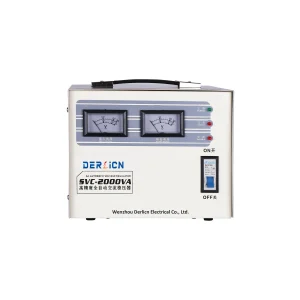
Servo Motor Type Voltage Regulator/Voltage Stabilizer
Frequently Asked Questions (FAQs)
1. My AC is an “Inverter” model. Do I still need a stabilizer?
Yes. While inverter ACs are better at handling slight variations, they are actually more sensitive to voltage spikes and extreme low voltage. The power PCB (Printed Circuit Board) in an inverter AC is very expensive to replace. A stabilizer acts as a shield for these delicate electronics.
2. Can a stabilizer lower my electricity bill?
Not directly, but indirectly, yes. When an AC runs at the correct voltage, the compressor operates at peak efficiency. At low voltage, the motor runs hot and inefficiently, wasting energy. By providing a steady 230V, the stabilizer ensures your AC consumes exactly what it was designed to.
3. What is “Digital Delay” in a stabilizer?
This is a critical feature for ACs. When the power cuts out and comes back instantly, the refrigerant pressure in the AC is still high. Attempting to restart immediately can damage the motor. A stabilizer with a 3-minute delay ensures the pressures equalize before allowing the AC to restart.
4. Does it need to be IEC compliant?
Absolutely. Look for IEC 60947-1 or IEC 60947-4 compliance. This ensures the contactors and switches inside the stabilizer can handle the heavy “breaking” and “making” of current without welding shut.
Conclusion: Protect Your Cool
In modern infrastructure, “Power Quality” is just as important as “Power Quantity.” If your air conditioner is struggling to keep you cool, don’t assume the machine is broken. It is likely just “starving” for stable voltage.
Investing in a high-quality AC voltage stabilizer is a one-time cost that pays for itself by preventing expensive compressor replacements and reducing “nuisance” service calls.
Don’t let poor power ruin your comfort. Our factory has over a decade of experience in engineering stabilized power solutions for the most demanding climates on Earth. From residential split units to industrial-grade HVAC, we provide the “missing link” that keeps the world cool.
Table of Contents
Have you Any Questions?
Can’t find an answer to your question, or want more information about our products? If so, please feel free to get in touch with our professional team. We’re here to help you drive your projects to success.