
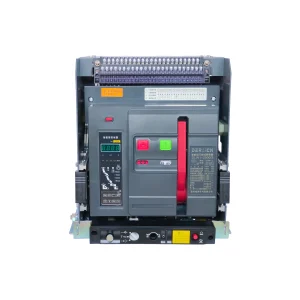
In large-scale industrial and commercial power systems, the Air Circuit Breaker (ACB) is the final line of defense for the main distribution panel. While standard molded-case breakers handle branch circuits, the ACB manages the massive current loads of the entire facility.
Because ACBs are mechanical masterpieces with complex linkages and electronic trip units, they require a rigorous preventive maintenance schedule to ensure they operate in the few milliseconds required during a catastrophic fault.
Technical Note on Voltage: While ACBs are the primary protection in “Main Switchgear Panels,” they are technically Low-Voltage (LV) devices, typically rated for systems up to 1000V (common in 400V/415V/690V industrial grids). For systems above 1kV (Medium/High Voltage), Vacuum Circuit Breakers (VCBs) or SF6 breakers are utilized.
Neglecting an ACB is a high-risk gamble. Over time, dust, hardened grease, and contact oxidation can lead to “sluggish” operation. In a short-circuit event, a delay of even 100 milliseconds can be the difference between a standard trip and a devastating arc-flash explosion.
The following checklist is designed for qualified electrical engineers and follows the general guidelines of IEC 60947-2 and NFPA 70B.
Safety and Pre-Maintenance Protocol
Before any physical contact with the ACB, safety protocols are non-negotiable.
Isolate the Power: Ensure the upstream breaker is open and locked out.
LOTO (Lockout/Tagout): Apply personal locks and tags to the isolation point.
Discharge Springs: Ensure the closing and opening springs are discharged (check the “Spring Charged” indicator).
Rack Out: For draw-out versions, move the ACB to the “Disconnected” or “Test” position.
Visual and Physical Inspection
Enclosure and Frame: Check for signs of overheating, discoloration, or tracking (carbon paths) on the insulating parts.
Arc Chutes: Remove and inspect the arc chutes. Look for cracked ceramic plates or excessive soot.
Action: Clean with a vacuum or dry cloth; replace if plates are eroded by more than 25%.
Main Contacts: Inspect the silver-plated contacts for pitting, erosion, or signs of welding.
Terminal Connections: Check for tightness and signs of thermal stress (blue/black discoloration of copper).
Mechanical Servicing
The mechanical linkage of an ACB is prone to “stiffness” if left in the closed position for years.
Cleaning: Use a non-residue electronic cleaner to remove old, dust-laden grease.
Lubrication: Apply a thin layer of manufacturer-approved synthetic grease (usually molybdenum-disulfide based) to the pivot points and rollers.
Warning: Never lubricate the actual electrical contact surfaces or the trip latch.
Manual Operation: Perform at least 3–5 manual Open/Close cycles to ensure the mechanism is “supple” and the charging handle operates smoothly.
Electrical and Insulation Testing
Quantitative testing provides the “health report” of the breaker.
A. Insulation Resistance (IR) Test
Use a 1000V Megger to test the insulation between:
Phase-to-Phase (L1-L2, L2-L3, L3-L1)
Phase-to-Earth
Requirement: Values should typically be > 100 M$\Omega$.
B. Contact Resistance (Micro-Ohm) Test
Since ACBs carry high current, a high-resistance contact will generate immense heat (P=I2R).
Procedure: Inject 100A DC across the closed contacts and measure the voltage drop.
Requirement: Resistance should be extremely low, usually < 50 \mu \Omega$ (check manufacturer specific tolerances).
Protection and Trip Unit Testing
The Electronic Trip Unit (ETU) is the “brain” that detects overloads and short circuits.
Secondary Injection Testing: Use a specialized test kit to simulate fault currents (L, S, I, and G parameters) directly into the trip unit.
Cause of Trip: Verify that the “Trip Flag” or digital display correctly identifies the type of fault simulated.
Battery Check: If the trip unit has an internal battery (for the display/memory), test the voltage and replace if it has been in service for more than 2 years.
Summary Maintenance Checklist Table
| Component | Task | Frequency (Standard) |
|---|---|---|
| Arc Chutes | Clean and inspect for cracks | Annual |
| Main Contacts | Check for pitting/oxidation | Annual |
| Mechanical Linkage | Clean and re-lubricate | 2 Years |
| Trip Unit | Secondary Injection Test | 2 Years |
| Insulation (IR) | Megger Test (1000V) | Annual |
| Control Wiring | Check tightness of terminals | Annual |
Why Maintenance is Essential for Insurance Compliance
Beyond safety, regular ACB maintenance is often a requirement for industrial insurance policies. In the event of an electrical fire, the first document an investigator will request is the Maintenance Log of the main incoming breaker.
Providing a stamped report showing passed Contact Resistance and Secondary Injection Tests can be the deciding factor in a successful insurance claim and avoids the liability associated with “negligent maintenance.”
Conclusion
A well-maintained Air Circuit Breaker can provide reliable service for 20 to 30 years. However, a single year of neglect in a harsh, dusty, or humid environment can lead to mechanical failure. By following a structured ACB maintenance checklist, facility managers ensure that their “guardians” are always ready to respond to a fault, protecting both personnel and expensive downstream assets like transformers and motors.
Always document every test result, including ambient temperature and humidity, to build a “trend analysis” over the life of your switchgear.
Ensure Your System’s Longevity Are you looking for high-reliability ACBs for a new installation or seeking technical support for existing switchgear? Our team provides comprehensive technical files and support for all our certified ACB series.
[Contact our export team for technical documentation or a custom quote for your next project.]
Table of Contents
Have you Any Questions?
Can’t find an answer to your question, or want more information about our products? If so, please feel free to get in touch with our professional team. We’re here to help you drive your projects to success.