
In the design of any electrical distribution network—from a residential unit to a massive industrial factory—circuit protection is non-negotiable. The Miniature Circuit Breaker (MCB) and the Molded Case Circuit Breaker (MCCB) are the front-line soldiers in this defense.
However, a common mistake in early-stage project planning is assuming these devices are interchangeable based on size alone. Using an MCB where an MCCB is required can lead to inadequate protection against high-fault currents, while using an MCCB for simple domestic circuits is an unnecessary expenditure.
Below are the five defining differences between these two essential components.
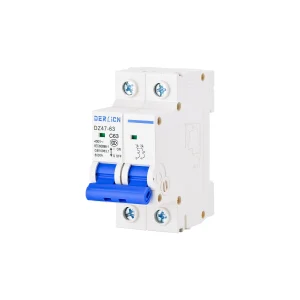
Miniature Circuit Breaker (MCB)
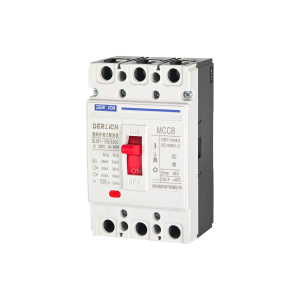
Molded Case Circuit Breaker (MCCB)
Current Rating and Operating Range (In)
The most immediate distinction is the volume of current the device is designed to handle.
MCB (Miniature Circuit Breaker): These are designed for low-current applications. Typically, their rated current (In) ranges from 0.5A up to 125A. They are the standard for final distribution circuits where the load is relatively small, such as lighting, wall sockets, and small appliances.
- MCCB (Molded Case Circuit Breaker): These are the “heavy lifters.” Their current ratings start where MCBs usually end, ranging from 15A up to 2500A (and sometimes higher in specialized frames).
- Technical Insight: If your application involves heavy machinery or a main incoming line for a commercial building, an MCCB is the only viable choice to handle the high continuous load.
Breaking Capacity (Icu)
Breaking capacity, or Interrupting Rating, refers to the maximum fault current (short circuit) the breaker can safely interrupt without being destroyed.
- MCB: Since they are used in domestic and light commercial settings where the “Prospective Short Circuit Current” (PSCC) is relatively low, MCBs usually have a breaking capacity of 6kA to 10kA.
- MCCB: Industrial environments are often located close to large transformers, meaning the potential fault currents are much higher. MCCBs are engineered to handle breaking capacities ranging from 10kA to 100kA+.
Adjustability of Trip Settings
This is perhaps the most significant difference for system engineers focusing on selectivity and coordination.
MCB: These units have fixed trip characteristics. When you buy a “Type C 32A” MCB, the thermal and magnetic trip points are set at the factory and cannot be changed. This simplicity is ideal for residential use but lacks flexibility.
MCCB: Most MCCBs feature adjustable trip settings. In standard thermal-magnetic MCCBs, you can often adjust the thermal threshold (e.g., from 0.8 to 1.0×In). In advanced electronic MCCBs, you can adjust the Long-time, Short-time, and Instantaneous (LSI) settings to perfectly match the load curve.
International Standards and Design Logic
While both fall under the broad umbrella of low-voltage switchgear, they are governed by different international standards that reflect their intended use.
IEC 60898-1: This is the standard for MCBs intended for household and similar installations. It assumes the devices will be operated by “uninstructed persons” (non-engineers) and used in clean, dry environments.
IEC 60947-2: This is the industrial standard that governs MCCBs. It is far more rigorous, covering devices used in “industrial applications” where they may be operated by skilled personnel and must withstand harsher environmental conditions, higher vibrations, and more complex electrical “noise.”
Accessory Integration and Remote Control
As power systems become “smarter,” the ability to monitor and control breakers remotely is vital.
MCB: While some high-end MCBs allow for basic auxiliary contacts or shunt trips, they are generally limited. Their compact size doesn’t allow for extensive internal modifications.
MCCB: These are designed as modular systems. You can easily add Motor Operators for remote switching, Shunt Trips for emergency shutdowns, Undervoltage Releases, and Communication Modules (like Modbus) to transmit data to a SCADA system.
Technical Comparison Table
| Feature | MCB (Miniature) | MCCB (Molded Case) |
|---|---|---|
| Current Rating (In) | Up to 125A | Up to 1600A |
| Breaking Capacity (Icu) | Up to 10kA (standard) | Up to 100kA+ |
| Trip Characteristics | Fixed | Fixed & Adjustable (L, S, I settings) |
| Primary Standard | IEC 60898-1 | IEC 60947-2 |
| Application | Residential / Light Commercial | Industrial / Commercial Main Panels |
| Accessories | Limited | Extensive (Motor, AUX, SHT, UVR) |
| Poles | 1P, 2P, 3P, 4P | 1P, 2P, 3P, 4P |
When to Choose Which? (Selection Guidance)
Choose an MCB if:
Low Current: Your load is consistently under 100A.
Domestic/Office Use: You are protecting lighting circuits, air conditioners, or office computers.
Space is Limited: You are using a standard consumer unit with DIN-rail mounting.
Cost: You need a simple, cost-effective solution for a final branch circuit.
Choose an MCCB if:
High Current: The load exceeds 125A.
Industrial Environment: You are protecting motors, large transformers, or heavy welding equipment.
High Fault Potential: The installation is near a substation or main power intake.
Requirement for Remote Control: You need to integrate the breaker into a Building Management System (BMS).
Selectivity: You need to coordinate multiple layers of breakers to ensure only the local fault trips.
Frequently Asked Questions (FAQs)
1. Can I use an MCCB for a 20A circuit?
Technically, yes. MCCBs are available in low amperages. However, it is rarely done because an MCCB is significantly larger and more expensive than an MCB. You would only do this if the breaking capacity required is higher than 10kA.
2. What is the lifespan difference?
MCCBs are generally built for higher endurance. While an MCB is often replaced after a few major trips, an MCCB—especially the “Class PC” or electronic variants—is designed for thousands of operations and can often be maintained rather than just replaced.
3. Do MCBs require maintenance?
MCBs are essentially “fit and forget” devices. If they fail, they are replaced. MCCBs in industrial settings should undergo periodic thermal imaging and contact resistance testing to ensure they remain safe.
4. Why are MCCBs adjustable?
Adjustability allows engineers to ensure that the breaker doesn’t trip during normal motor startups (which have high inrush current) but still trips quickly during a genuine fault. This balance is harder to achieve with fixed MCBs.
Conclusion
Understanding the “MCB vs. MCCB” distinction is a cornerstone of safe electrical engineering. By matching the breaker to the specific current demands, fault potential, and environmental needs of your project, you ensure a system that is not only compliant with IEC standards but also optimized for longevity.
For international buyers and project managers, specifying the correct breaker type in your request list or technical files is the first step toward a successful installation.
Reliable Protection for Your Infrastructure Whether you need high-volume MCBs for residential projects or precision-engineered MCCBs for industrial switchgear, we offer a full range of certified electrical solutions. Our products are tested to the highest international standards to ensure your safety and peace of mind.
[Explore our Product Catalog or Request a Technical Consultation Today]
Table of Contents
Have you Any Questions?
Can’t find an answer to your question, or want more information about our products? If so, please feel free to get in touch with our professional team. We’re here to help you drive your projects to success.