
In the high-stakes environment of industrial manufacturing, electrical faults are more than just a safety hazard—they are a threat to productivity. An improperly selected MCCB can lead to two disastrous outcomes: failing to trip during a genuine fault (causing fire or equipment destruction) or “nuisance tripping” (causing unnecessary downtime).
To select the correct Molded Case Circuit Breaker, one must look beyond the physical size and focus on the technical parameters defined by the IEC 60947-2 standard.
Defining the Rated Current (In) and Operating Voltage (Ue)
The most fundamental step is determining the load the breaker will carry and the voltage at which it will operate.
Rated Current (In)
The rated current is the maximum amount of current the MCCB can carry continuously at a specified ambient temperature (usually 40°C) without tripping.
The 80% Rule: In many engineering designs, it is standard practice to size the MCCB so that the continuous load does not exceed 80% of its rated current to account for ambient heat and prevent long-term fatigue of the thermal element.
Future Proofing: Consider a 20% margin for future equipment additions to the distribution board.
Rated Operational Voltage (Ue)
The Ue must be equal to or higher than the system voltage. In industrial settings, this is typically 400V or 415V for three-phase systems, but specialized applications (like mining or maritime) may require 690V or higher.
Understanding Breaking Capacity: Icu vs. Ics
One of the most frequent points of confusion in MCCB selection is the difference between Ultimate Breaking Capacity and Service Breaking Capacity.
Ultimate Short-Circuit Breaking Capacity (Icu)
This is the maximum fault current the Molded Case Circuit Breaker can interrupt safely. After clearing a fault at Icu levels, the breaker is typically no longer fit for service and must be replaced.
Service Short-Circuit Breaking Capacity (Ics)
This is the fault current the Molded Case Circuit Breaker can interrupt and remain operational. It is expressed as a percentage of Icu (e.g., 50%, 75%, or 100%).
Selection Logic: For critical industrial infrastructure, always aim for Ics=100% of Icu. This ensures that after a standard fault is cleared, the breaker can be reset and service can resume immediately without compromising safety.
Selecting the Right Trip Unit Technology
The trip unit is the intelligence of the Molded Case Circuit Breaker. Your choice here depends on the sensitivity of your equipment and the need for system coordination.
Thermal-Magnetic Trip Units
Best for: Simple distribution, lighting, and general-purpose loads.
Pros: Cost-effective, robust, and easy to replace.
Cons: Limited adjustability; sensitive to ambient temperature changes.
Electronic Trip Units (ETU)
Best for: Critical machinery, data centers, and systems requiring high selectivity.
Pros: Highly precise, immune to temperature, and allows for LSI (Long, Short, Instantaneous) adjustments.
Cons: Higher initial cost.
Technical Tip: If your industrial site uses Variable Frequency Drives (VFDs) or heavy automation, an Electronic Trip Unit is highly recommended to handle the complex harmonics and provide the precision needed to prevent nuisance trips.
Matching the MCCB to the Load Type
Not all loads behave the same way during startup. Choosing an Molded Case Circuit Breaker requires understanding the “inrush” characteristics of your equipment.
Motor Protection
Motors draw significantly higher current during startup (typically 6–10 times the rated current).
Specialized MCCBs: Use Molded Case Circuit Breakers specifically designed for motor protection. These have a magnetic trip threshold set high enough to allow for the starting inrush but sensitive enough to detect a stalled rotor or phase loss.
Transformer Protection
Transformers create a massive, momentary “magnetizing inrush” when energized. The Molded Case Circuit Breaker must have an instantaneous trip setting (Ii) high enough to prevent tripping during this millisecond-long spike.
Distribution Protection
For standard cables and lighting, a general-purpose Molded Case Circuit Breaker with standard B, C, or D trip curves (if applicable) is sufficient.
Coordination, Selectivity, and Cascading
In a well-designed industrial power system, a fault should only shut down the smallest possible section of the network. This is known as Selectivity (or Discrimination).
Total Selectivity: The downstream breaker trips, and the upstream breaker remains closed.
Cascading (Back-up Protection): This is a cost-saving technique where a higher-capacity upstream breaker “assists” a lower-capacity downstream breaker. While this saves money on the downstream MCCB, a fault might trip both breakers, causing a wider blackout.
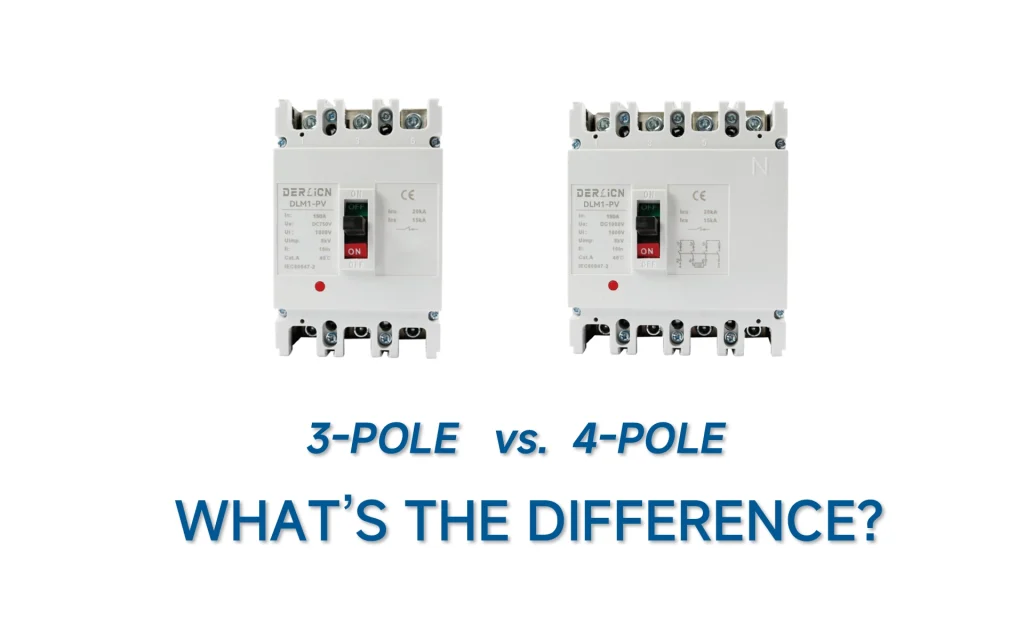
Number of Poles and Physical Configuration
The choice of poles is dictated by your grounding system and local electrical codes.
3-Pole (3P): Standard for three-phase motor loads where the neutral is not required.
4-Pole (4P): Used when the neutral needs to be disconnected for safety or in systems with unbalanced loads (e.g., 400V systems feeding 230V lighting).
Fixed vs. Plug-in: For factories where downtime is unacceptable, consider Plug-in or Draw-out versions. These allow for the rapid replacement of a breaker without disconnecting the main busbar.
Environmental and Operational Factors
1. How do I calculate the MCCB rating for a 3-phase motor?
As a rule of thumb, for a standard 400V motor, the full load current (FLC) is roughly 1.5 to 2 times the kilowatt (kW) rating. The MCCB should be sized at 1.25 to 1.5 times the FLC, but always verify with the motor’s nameplate and startup curve.
2. Can I use an MCCB as a main switch?
Yes, provided the MCCB is rated for isolation (indicated by a specific symbol on the nameplate: a line with a perpendicular bar). Most modern IEC-compliant MCCBs serve as both a protective device and a disconnector.
3. What is the difference between MCCB and MCB?
MCBs (Miniature Circuit Breakers) are generally for currents below 125A and have fixed trip settings. MCCBs are for higher currents (up to 2500A) and offer adjustable settings and higher breaking capacities.
4. Why does my MCCB trip even when the load is below the rated current?
This is often due to ambient heat (thermal tripping) or loose connections at the terminals. Loose wires create localized heat that tricks the thermal element into thinking there is an overload.
Frequently Asked Questions (FAQs)
1. Does a PC Type ATS require a fuse?
Not necessarily a fuse, but it must have an upstream overcurrent protective device (breaker or fuse). Using a PC type without upstream protection is a violation of IEC 60947 standards and a major fire hazard.
2. Can I use a CB Type ATS as a service entrance?
Yes. Because CB Type ATS units have built-in overcurrent protection, they are often used as the “Service Entrance” equipment where the utility power first enters the building.
3. Which type is easier to maintain?
PC Type units are generally easier to maintain because they are simpler. CB Type units require checking the motor drive, the mechanical interlock alignment, and the trip settings of the internal breakers.
4. What is Class CC?
While less common than CB and PC, Class CC refers to an ATS based on contactors. It is similar to a PC type in that it has no overcurrent protection but is typically used for smaller, lighter-duty applications.
Conclusion
Choosing the right MCCB is a balance of technical rigor and practical foresight. By prioritizing Ics=100%Icu, selecting appropriate trip unit technology, and ensuring selectivity, you protect not just your electrical components, but the continuity of your entire business.
Always consult your manufacturer’s technical files and ensure that the selected breaker carries the necessary CE certifications for your region.
Streamline Your Procurement Process Need a reliable partner for your electrical infrastructure? We provide high-performance MCCBs, including the DLM1 and DLM3 series, with a full range of accessories and technical documentation.
Table of Contents
Have you Any Questions?
Can’t find an answer to your question, or want more information about our products? If so, please feel free to get in touch with our professional team. We’re here to help you drive your projects to success.