
In any modern infrastructure—be it a sprawling industrial complex, a high-rise commercial office, or a data center—the distribution of electricity is a critical operation. While the transformer brings power to the site, the electrical distribution board (DB) serves as the “nerve center” of the entire electrical installation.
For electrical engineers and facility managers, understanding the nuances of these boards is not just about keeping the lights on; it is about ensuring system reliability, protecting expensive machinery, and maintaining rigorous safety standards. This article provides a comprehensive technical breakdown of what electrical distribution boards do, how they are constructed, and how to select the right one for your application.
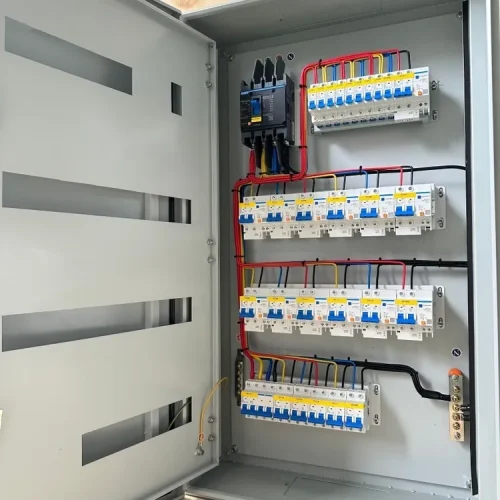
The Primary Functions of an Electrical Distribution Board
At its core, an electrical distribution board is a component of an electricity supply system that divides an electrical power feed into subsidiary circuits while providing a protective fuse or circuit breaker for each circuit in a common enclosure. However, its role extends far beyond simple “splitting.”
1. Power Distribution and Load Management
The primary purpose of a distribution board is to take a single incoming power source and distribute it to various branch circuits. By doing so, it allows for the granular control of power throughout a facility. For instance, in an industrial plant, a main distribution board might feed several sub-distribution boards, which in turn power specific production lines, lighting systems, and HVAC units.
2. Circuit Protection
Safety is the most critical function of any DB. Each subsidiary circuit is equipped with protective devices—typically Miniature Circuit Breakers (MCBs) or Molded Case Circuit Breakers (MCCBs). These devices protect the system from two primary faults:
Overload: Occurs when too many devices are connected to a single circuit, drawing more current than the wires can safely handle.
Short Circuits: Occurs when a low-resistance path is created (often due to insulation failure), leading to a massive spike in current that could cause fires or explosions.
3. Equipment Isolation
Maintenance is a reality in any electrical system. Distribution boards allow engineers to isolate specific sections of a building’s electrical network without shutting down the entire facility. By tripping a specific breaker or opening an isolator switch, a technician can safely work on a downstream circuit.
4. Safety Against Earth Leakage
Modern distribution boards often incorporate Residual Current Devices (RCDs) or Residual Current Breakers with Overcurrent protection (RCBOs). These components monitor the balance of current between the live and neutral conductors. If a leak to the earth is detected (which could indicate a person receiving an electric shock), the device trips instantly, potentially saving lives.
Internal Components: The Anatomy of a Distribution Board
To understand what a distribution board does, one must look at the precision-engineered components housed within its enclosure.
Main Switch / Isolator
The main switch is the point of entry for the incoming power supply. It allows for the entire board to be de-energized in a single action. In industrial applications, this is often a heavy-duty MCCB or an air circuit breaker (ACB) for higher current ratings.
Busbars
Busbars are solid strips of copper or aluminum that conduct electricity within the board. They act as the “highway” that carries current from the main switch to the individual circuit breakers. The cross-sectional area of the busbar is critical, as it determines the board’s total current-carrying capacity.
Protective Devices (MCBs, MCCBs, and Fuses)
MCB (Miniature Circuit Breaker): Generally used for lower current applications (up to 125A). They are standard in lighting and small power circuits.
MCCB (Molded Case Circuit Breaker): Used for higher current ratings (up to 2500A) and adjustable trip settings, making them ideal for heavy machinery.
SPD (Surge Protection Device): Protects sensitive electronic equipment from voltage spikes caused by lightning strikes or switching transients on the grid.
Neutral and Earth Links
These busbars provide a common termination point for all neutral and grounding wires. Proper grounding is essential for the operation of protective devices and the prevention of electric shock.
Technical Standards and Compliance: IEC 61439
In the world of electrical engineering, reliability is synonymous with standardization. The gold standard for electrical distribution boards (referred to technically as “Low-voltage switchgear and controlgear assemblies”) is the IEC 61439 series.
Importance of Type Testing
Under IEC 61439, a distribution board is no longer seen as a collection of individual parts but as a “system.” Manufacturers must verify the assembly through:
Temperature rise limits: Ensuring the board doesn’t overheat under full load.
Dielectric properties: Testing the insulation’s ability to withstand voltage surges.
Short-circuit withstand strength: Proving the board can survive the mechanical and thermal stresses of a high-current fault.
For industrial buyers, specifying IEC 61439 compliant boards is the only way to guarantee that the equipment will perform as expected during a fault.
Types of Distribution Boards
Depending on the application, distribution boards are categorized into several types:
| Type | Application | Features |
|---|---|---|
| Main Distribution Board (MDB) | Primary intake for a building | High current capacity, often includes ACBs or large MCCBs. |
| Sub-Distribution Board (SDB) | Fed from an MDB to a specific floor/area | Provides localized control and protection. |
| Final Distribution Board | The last point before the end-user load | Houses MCBs and RCDs for lighting and sockets. |
| Motor Control Centers (MCC) | Industrial automation | Specialized for starting and protecting electric motors. |
Industry Applications
Industrial Manufacturing
In manufacturing, downtime is measured in thousands of dollars per minute. Distribution boards in this sector must handle “dirty” power environments, high vibrations, and heavy inductive loads from motors. They often require higher IP (Ingress Protection) ratings, such as IP65, to protect against dust and moisture.
Commercial Real Estate
For high-rise offices, the focus is on “Selectivity” or “Discrimination.” This means if a fault occurs in a single office, only the local breaker trips, leaving the rest of the floor—and the building—powered.
Data Centers
In data centers, distribution boards are part of a redundant power chain. They often include integrated power monitoring to track energy consumption (kWh) and power quality (harmonics) in real-time.
Selection Guidance: Choosing the Right Board
When selecting an electrical distribution board for a project, engineers should evaluate the following criteria:
Current Rating (Amperage): Calculate the total connected load plus potential future expansion (usually a 20% margin).
Short-Circuit Rating (Icc): Ensure the board can withstand the prospective short-circuit current available at the point of installation.
Number of Ways: Choose a board with enough “ways” (slots for breakers) for current needs plus spares.
Ingress Protection (IP Rating): * IP20/30: Standard indoor use.
IP65/66: Outdoor or wash-down industrial environments.
Form of Separation: In industrial settings, “Form 4” separation ensures that busbars, terminals, and units are physically partitioned, allowing for maintenance on one circuit while others remain live.
Maintenance and Best Practices
A distribution board is not a “fit and forget” component. To ensure longevity:
Thermal Imaging: Conduct annual infrared thermography to identify “hot spots” caused by loose connections or overloaded circuits.
Torque Checks: Periodically verify that terminal screws are tightened to the manufacturer’s specified torque.
Dust Management: Accumulation of conductive dust can lead to tracking and phase-to-phase faults.
Frequently Asked Questions (FAQs)
What is the difference between a distribution board and a panelboard?
In many regions, the terms are used interchangeably. However, “distribution board” is the more common international (IEC) term, while “panelboard” is frequently used in North American (UL/NEMA) contexts to describe a single panel accessible only from the front.
Can I mix different brands of breakers in one board?
It is strongly discouraged and often a violation of safety standards. Distribution boards are tested as a complete assembly. Mixing brands can lead to poor busbar contact, overheating, and failure of the protective device to trip during a fault.
What does the “IP Rating” mean for a distribution board?
The IP (Ingress Protection) rating defines the enclosure’s effectiveness against the intrusion of solids (like dust) and liquids. For example, an IP65 board is dust-tight and protected against water jets.
Conclusion
Electrical distribution boards are the unsung heroes of industrial and commercial infrastructure. By efficiently dividing power, providing critical circuit protection, and ensuring compliance with international safety standards like IEC 61439, they form the backbone of a safe electrical installation.
Whether you are designing a new facility or upgrading an existing one, selecting a high-quality, professionally engineered distribution board is the most effective way to protect your equipment and your personnel.
Looking for high-performance distribution solutions?
Derlicn Electric specializes in IEC-compliant, custom-engineered electrical distribution boards for industrial and commercial applications. [Contact our engineering team today for a technical consultation or a custom quote.]
Table of Contents
Have you Any Questions?
Can’t find an answer to your question, or want more information about our products? If so, please feel free to get in touch with our professional team. We’re here to help you drive your projects to success.