
As the global transition toward decentralized renewable energy accelerates, the complexity of residential and industrial microgrids has increased. For electrical engineers and system integrators, the core challenge lies in the seamless management of multiple power sources. A solar transfer switch, specifically an Automatic Transfer Switch (ATS), is the critical component that facilitates the transition between utility grid power and solar-derived power (often stored in battery banks or provided via a standby inverter).
In the context of modern Photovoltaic (PV) systems, the solar transfer switch ensures that critical loads remain energized during grid outages while preventing “backfeeding”—the dangerous injection of electricity into a dead utility grid. This guide provides a deep technical analysis of ATS technology within solar architectures, focusing on operational logic, hardware configurations, and selection criteria for high-reliability applications.

What is a Solar Transfer Switch?
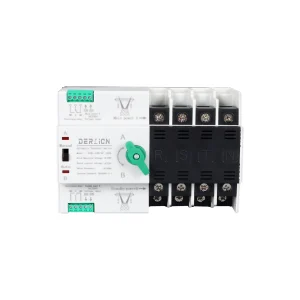
A solar transfer switch is a specialized electrical device that toggles a load connection between two independent power sources: the primary source (usually the utility grid) and an alternate source (the solar inverter or battery storage system).
Technically, it functions as a sophisticated double-throw switch. In a grid-tied system with backup, the solar transfer switch monitors the health of the utility supply. If the voltage or frequency deviates beyond programmed tolerances, the switch disconnects from the grid and connects the load to the solar backup system. Once the grid returns to a stable state for a predetermined duration, the ATS transitions the load back to the primary source.
Beyond simple switching, these devices are engineered to handle high inrush currents and provide isolation that satisfies safety standards such as UL 1008 and NEC Article 705.
How Does a Solar Transfer Switch Work?
The operation of a solar transfer switch is governed by a dedicated logic controller that continuously samples the electrical parameters of both the grid and the solar inverter output.
1. Sensing and Monitoring
The ATS controller measures the Root Mean Square (RMS) voltage and frequency. If the utility voltage Vgrid drops below a threshold (typically 80% of nominal) or exceeds a limit (110%), the controller initiates the transfer sequence.
2. The Transfer Sequence (Break-Before-Make)
Most solar ATS units utilize a “Break-Before-Make” (BBM) transition. This is a safety-critical logic that ensures the two power sources are never connected simultaneously.
Step A: The switch opens the connection to the Utility Grid.
Step B: A momentary “dead” period (measured in milliseconds) occurs to allow any residual voltage from inductive loads to decay and to ensure arc quenching.
Step C: The switch closes the connection to the Solar/Battery Inverter.
3. Switching Time and Synchronization
For sensitive electronics, the switching time is paramount. Most modern solar ATS units achieve transitions in under 20–50 milliseconds. In high-end “In-Phase” transfer switches, the controller waits until the phase angle of the solar inverter matches the phase angle of the grid before switching back, minimizing the mechanical stress on motors and the electrical surge on the system.
Main Components of a Solar Transfer Switch
A robust solar transfer switch is comprised of several industrial-grade components designed for thousands of cycles under load.
- Logic Controller: A microprocessor-based unit that handles the sensing, timing, and command signals.
- Switching Mechanism: This is the physical hardware that moves the contacts. In smaller systems, these are heavy-duty electromagnetic relays; in larger industrial systems, they are motorized molded-case switches or insulated-case power breakers.
- Arc Chutes: Assemblies made of insulating plates that split and extinguish the electrical arc generated when contacts open under load.
- Contact Assembly: Typically silver-alloy plated to provide high conductivity and resist welding during high-current faults.
- Terminal Blocks: High-torque lugs designed to accommodate the specific wire gauges required for the system’s ampacity.
Types of Solar Transfer Switches
Depending on the project’s scale and the sensitivity of the loads, there are three primary types of transfer switches used in solar integration.
1. Manual Transfer Switch (MTS)
Requires a human operator to physically flip the switch.
Use Case: Small off-grid cabins or non-critical residential backup where a brief outage is acceptable.
Benefit: Lowest cost and zero standby power consumption.
2. Automatic Transfer Switch (ATS) – Relay Based
Uses electromagnetic coils to hold contacts in position.
Use Case: Residential solar backup systems.
Benefit: Fast response and relatively compact. However, they can hum slightly and have higher standby losses.
3. Motorized / Contactor-Based ATS
Uses a motor or a powerful solenoid to mechanically “lock” the switch into position.
Use Case: Industrial solar plants, data centers, and large-scale commercial PV installations.
Benefit: High short-circuit withstand ratings (WCR) and extremely reliable for high-ampacity loads.
4. Static Transfer Switch (STS)
Uses power semiconductors (SCRs) instead of mechanical contacts.
Use Case: Mission-critical facilities where even a 20ms outage is too long.
Benefit: Near-instantaneous switching ($<$4ms).
Applications of a Solar Transfer Switch
The integration of a solar transfer switch is indispensable in several modern electrical architectures:
- Residential Load Shedding: Connecting only “critical loads” (refrigerators, well pumps, security) to the solar backup during a grid failure.
- Hybrid Microgrids: Managing the balance between solar, wind, and diesel generators in remote industrial sites.
- Telecom Base Stations: Ensuring 100% uptime for communication equipment by switching to solar/battery storage the moment the primary line fails.
- Net-Zero Commercial Buildings: Utilizing the ATS to prioritize solar self-consumption during peak tariff hours and switching to the grid only when battery levels are depleted.
Advantages of a Solar Transfer Switch
Implementing an automated solar transfer switch offers significant technical advantages for power quality and safety:
- Anti-Islanding Protection: It ensures that your solar system does not feed power back into the utility lines during a blackout, which is a mandatory safety requirement to protect utility linemen.
- Seamless Continuity: Minimizes downtime for critical appliances, preventing the need to manually reset clocks, servers, or industrial controllers.
- Battery Health Optimization: Advanced ATS units can be programmed to switch to the grid when batteries reach a specific Depth of Discharge (DoD), extending the lifespan of the battery bank.
- Compliance: Simplifies the process of meeting building codes and electrical standards (NEC 702 and 705).
How to Choose the Right Solar Transfer Switch
For contractors and engineers, the selection process must be rigorous. A mismatch between the ATS and the PV system can lead to contact welding or logic failures.
1. Ampacity and Voltage Rating
The ATS must be rated for the full load of the circuit it serves. If the main service is 200A, the ATS must be rated for at least 200A, even if the solar inverter only outputs 50A.
2. Number of Poles
2-Pole: Used for standard single-phase 120/240V systems where only the hot wires are switched.
3-Pole or 4-Pole: Required in three-phase systems or when the neutral must also be switched (Separately Derived Systems).
3. Transition Type
If the load includes sensitive servers or medical equipment, prioritize an ATS with a high-speed transition ($<$20ms). For heavy inductive loads (large motors), an “Open Transition” with a programmed neutral delay is safer to allow magnetic fields to dissipate.
4. Enclosure Rating
- NEMA 1: For indoor installations in clean environments.
- NEMA 3R: Required for outdoor installations to protect against rain and ice.
- NEMA 4X: For corrosive environments (e.g., coastal solar farms).
Common FAQs
Q1: Can I use a standard generator ATS for a solar system? Technically, yes, if the voltage and amperage match. However, “Solar-ready” ATS units often include additional logic for battery state-of-charge (SoC) monitoring or communication ports for solar inverters that standard generator switches lack.
Q2: What is the difference between an ATS and a Grid-Tie Inverter’s internal switch? Most grid-tie inverters have internal relays for anti-islanding. However, a dedicated solar transfer switch is usually required to create a “backup” sub-panel that can operate independently when the grid is down.
Q3: How fast does a solar ATS switch? A standard mechanical ATS typically switches in 20ms to 50ms. A static transfer switch (STS) can switch in less than 4ms.
Q4: Does an ATS require maintenance? Yes. For mechanical and motorized types, an annual inspection of the contacts for pitting or carbon buildup is recommended, along with a test of the manual override mechanism.
Q5: Is a neutral-switching ATS necessary for solar? It depends on how the solar inverter is grounded. If the solar system is considered a “separately derived system,” a switched neutral (3-pole for single phase) is often required by local codes to prevent ground loops.
Expert Support for Solar Infrastructure Integration
Designing a resilient PV-to-grid interface requires more than just high-quality panels; it requires a switching infrastructure that can withstand decades of operational stress. At [Company Name], we provide engineers and contractors with industrial-grade solar transfer switch solutions that are rigorously tested to UL 1008 standards. Our technical specialists can help you navigate the complexities of ATS sizing, coordination studies, and NEC compliance to ensure your solar project delivers uninterrupted power under any conditions.
Contact our power distribution team today to discuss your project specifications or to receive a technical submittal for our latest range of motorized and static solar transfer switches.
Conclusion
The solar transfer switch is the “traffic controller” of the modern energy-independent home or facility. By facilitating a safe, fast, and reliable transition between the utility grid and renewable reserves, it ensures that the investment in solar technology translates into true energy security. For the electrical professional, choosing an ATS with the correct withstand ratings, transition logic, and enclosure type is the difference between a system that merely functions and one that provides decades of resilient service.
Table of Contents
Have you Any Questions?
Can’t find an answer to your question, or want more information about our products? If so, please feel free to get in touch with our professional team. We’re here to help you drive your projects to success.