
Is Your Fridge Safe? 5 Signs You Need a Home Voltage Stabilizer
Your refrigerator is likely the most hardworking appliance in your home. Unlike a television or a microwave, it runs 24 hours a day, 7 days a week. In many regions, from the bustling markets of Sharjah to the expanding residential zones in East Africa, the modern double-door fridge represents a significant financial investment.
However, there is an invisible threat lurking in your wall socket: voltage fluctuation. In my years of overseeing electrical production and power protection manufacturing, I have seen thousands of high-end appliances destroyed not by age, but by poor power quality. While you might see the lights flicker, your refrigerator feels the “pain” in its most sensitive component—the compressor.
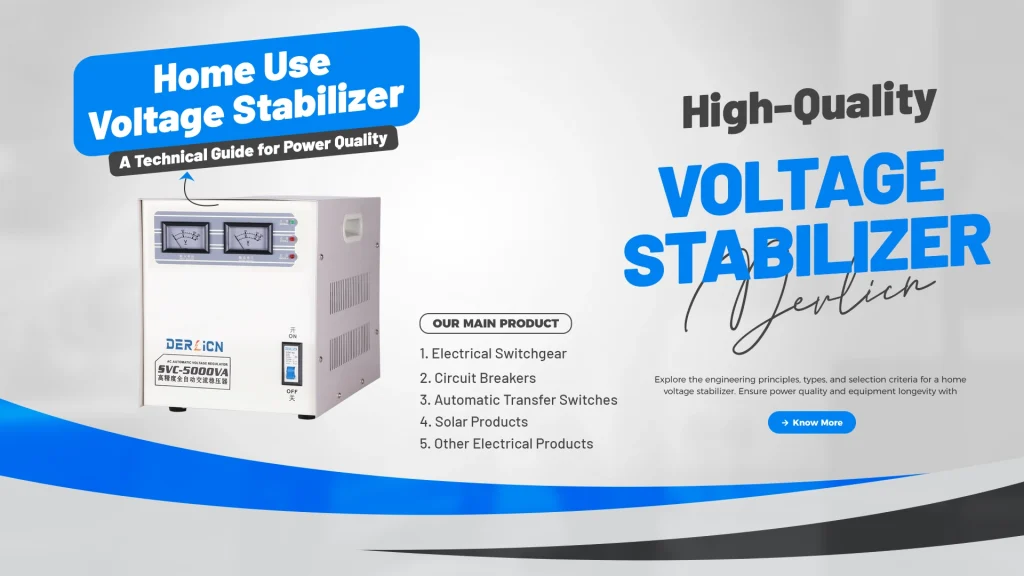
If your local grid is unstable, a home voltage stabilizer (also known as an AC voltage regulator) is no longer a luxury; it is an essential insurance policy for your kitchen.
5 Warning Signs Your Refrigerator is in Danger
As a manufacturer, we often advise our clients in the maritime and industrial sectors that “prevention is cheaper than replacement.” The same applies to your home. Here are the five critical signs that your power supply is killing your fridge.
1. Flickering or Dimming Household Lights
If your LED or incandescent bulbs dim when the fridge kicks on, or flicker randomly during the evening, your home is experiencing “voltage sags.”
In our factory’s R&D lab, we have conducted extensive stress tests on compressor motors. We’ve observed that when the voltage drops below 170V, the motor often fails to reach its operational speed. This is called “stalling.” A stalled motor continues to draw high current, causing the internal temperature of the windings to skyrocket. This leads to permanent insulation failure and a “burnt-out” compressor.
2. Strange Clicking or Heavy Humming Noises
Have you ever heard your fridge make a rhythmic “click… click…” sound without the cooling fan starting? That is the sound of the thermal overload protector tripping.
When the voltage is too low, the compressor lacks the “torque” to start against the pressure of the refrigerant gas. The humming noise is the motor struggling to turn. If this happens repeatedly, the internal mechanical parts experience premature wear, shortening a 10-year lifespan to just 2 or 3 years.
3. Frequent Short-Cycling
“Short-cycling” occurs when your refrigerator turns on and off much more frequently than usual. While this can sometimes be a thermostat issue, it is often a sign of power instability.
Voltage fluctuations can confuse the electronic control board of modern “Inverter” refrigerators. To protect itself from a perceived surge, the fridge shuts down, only to attempt a restart seconds later when the voltage stabilizes. This constant “on-off” cycle is incredibly taxing on the electronic sensors and relay switches.
4. Excessive Heat from the Back or Sides
While it is normal for a refrigerator to be slightly warm, excessive heat is a major red flag. High voltage (over-voltage) is just as dangerous as low voltage.
When the grid voltage exceeds the standard rating (e.g., rising above 250V in a 230V system), it forces more current through the components than they were designed to handle. This creates excessive heat that can melt plastic components, degrade the lubricant in the compressor, and even pose a fire risk.
5. Recent Local Power Surges or Blackouts
In regions like Kenya, Uganda, or the UAE, power restoration after a blackout is the most dangerous time for appliances. When the grid comes back online, it often carries a massive power surge or “transient” that can reach thousands of volts for a fraction of a second.
Without a stabilizer with a built-in “start delay” feature, your fridge will attempt to start the moment the power returns, potentially absorbing the full force of the surge.
Comparison: Which Stabilizer Technology is Right for You?
Not all stabilizers are created equal. Depending on your budget and the severity of your local power issues, you need to choose the right technology. At our manufacturing hub, we categorize them into three main types:
| Feature | Relay Type | Servo Motor Type | Static (SCR) Type |
|---|---|---|---|
| Accuracy | ±8% to 10% | ±1% to 3% (Very High) | ±1% (Precision) |
| Response Speed | Fast (Relay Switching) | Slower (Physical Motor Move) | Instantaneous |
| Durability | Moderate (Moving Relays) | High (Robust Transformer) | Highest (Solid State) |
| Best Use Case | Small fridges, low-budget homes. | Double-door fridges, ACs, Whole-house. | Medical equipment, high-end labs. |
| IEC Compliance | Usually IEC 60947-1 | Strict IEC 60947 Compliance | High-end Industrial |
Expert Recommendation: For most homeowners in unstable regions, a Servo Motor Type Home Voltage Stabilizer offers the best balance of cost and precision. It provides a “smooth” correction rather than the “stepped” correction of a relay type.
Frequently Asked Questions (FAQs)
1. Does a voltage stabilizer save electricity?
This is a common misconception. A stabilizer consumes a small amount of electricity to operate (usually 2-5% efficiency loss). However, it saves you money by ensuring your fridge motor runs at its peak efficiency. A motor running at low voltage is highly inefficient and wastes energy as heat.
2. What kVA size do I need for a double-door fridge?
The Rule of Three: A refrigerator compressor requires a massive “inrush current” to start—often 3 to 5 times its running current.
For a standard single-door fridge, a 1kVA stabilizer is usually sufficient.
For a large double-door or “Side-by-Side” fridge, we recommend at least a 2kVA or 3kVA unit to handle the startup load safely.
3. Can I use a simple surge protector instead?
No. A surge protector is like a fuse; it only “snaps” during a massive spike to stop a fire. It does not correct low voltage. If your voltage stays at 180V all afternoon, a surge protector will do nothing while your fridge motor slowly burns out. Only a home voltage stabilizer provides constant regulation.
4. Is it normal for a stabilizer to get warm?
Yes, it is normal for the casing to be warm to the touch (around 40-50°C) because the internal transformer is constantly working to “boost” or “buck” the voltage. however, if you smell burning plastic or the unit is too hot to touch, disconnect it immediately.
Conclusion
In the electrical manufacturing world, we talk about ROI (Return on Investment). A high-quality refrigerator can cost between $800 and $3,000. A reliable home voltage stabilizer costs a fraction of that amount.
By installing a stabilizer, you are not just buying a metal box; you are ensuring:
Zero downtime for your food storage.
Lower repair bills from burnt-out PCB boards.
Safety for your family against electrical fires caused by over-voltage.
Don’t wait for the next power cut to find out if your fridge will survive.
Protect your appliances today. Our factory in Zhejiang specializes in high-durability stabilizers designed specifically for the challenging grids of the Middle East and Africa.
Contact our engineering team at the factory for a bulk quote or a customized power solution for your region. We ensure all our products meet strict IEC 60947 compliance for global safety.
Table of Contents
Have you Any Questions?
Can’t find an answer to your question, or want more information about our products? If so, please feel free to get in touch with our professional team. We’re here to help you drive your projects to success.